

What Happens After You Hit Submit?
After applications are submitted and the giant feeling of relief has subsided, there are a few things to keep in mind.
After applications are submitted and the giant feeling of relief has subsided, there are a few things to keep in mind. Each school has their own timeline for when they will inform applicants of their admissions decision. In general, schools which have rolling admissions take 2-3 weeks, schools with Nov. 1 EA will inform you between mid-December and end of January, and schools with RD in January will inform you by end of February or March. So what do you do while you wait?
Within 2-3 days, most colleges will create an account on their website for you to check the status of your application and submit additional materials needed. Check your email consistently and make sure you do not miss these emails from your colleges. After receiving them, log in and check that the colleges have received all of your application requirements. While doing this, keep in mind that it may take some time for the websites to be updated as colleges are inundated with materials around their deadlines. If about a week after the deadline you still see that your application is missing something you have already sent, follow up with the admissions office. Although some colleges will send you a reminder that something is missing, you do not want to rely on that.
After applying, Florida students will need to connect their Student Self-Reported Academic Record to their applications of the schools which require them. These instructions will be on the Admissions website or sent via email. Also, financial aid forms such as the FAFSA and CSS Profile will need to be completed if they are not already. For some schools such as FSU, proof of residency will also be completed after the application is submitted. You will be able to see which of these materials you need by checking your new student account assigned to you.
If you do indeed find out that something is missing, do not overreact. Remember, with so many documents and emails being sent back and forth during such a short time span, it is very easy for something to get lost in the shuffle. If what is missing can be taken care of by you, do it right away. If it is something a counselor, teacher, or testing agency should have taken care of, politely follow up with them yourself. Whatever it may be, respectfully ask them to resend the materials as soon as they can. Confirm with the admissions office that you have taken care of it and verify if they have received the missing materials. While doing all of this, it is important that you advocate for yourself and be patient. Colleges would much rather hear from the students themselves than from a parent or counselor. You want to show them you are ready for college.
It should go without saying, but keep working hard and maintaining or improving your grades. Colleges ask for mid and final reports from your counselor for a reason! If you are given admission to a college and your grades sink, they have the right to revoke their offer. On the other hand, if you end up getting deferred or waitlisted, you want to be able to show progress to improve your chances of acceptance. No matter what your situation is, continuing to work hard and get good grades can only help.
Now try to relax and wait for your acceptance (hopefully) letters to roll in! Remember, there is a school for everyone and it WILL work out. Stay posted for my next article on what to do if you are waitlisted or deferred and how to weigh your options.
Additional Help:
FSU Admissions FAQs - https://admissions.fsu.edu/images/pdf/2019%20First%20Year%20Admissions%20FAQ.pdf
FAFSA Tips: https://www.nasfaa.org/fafsa_tips

Financial Aid Applications
As college application season is fully underway, it is important to learn about the primary financial aid applications and types of aid your student could receive. The two most common applications used by colleges across the US are the FAFSA and CSS PROFILE, and they need to be filed prior to each year the student plans on attending college.

As college application season is fully underway, it is important to learn about the primary financial aid applications and types of aid your student could receive. The two most common applications used by colleges across the US are the FAFSA and CSS PROFILE, and they need to be filed prior to each year the student plans on attending college.
The FAFSA (Free Application for Federal Student Aid) is the standard form used by all schools to determine the amount of federal aid a student will receive. The application opens online on October 1 each year and closes the following June 30. The FAFSA calculates the EFC (Expected Family Contribution), what the government considers a reasonable amount the family should be able to contribute to the student's educational costs whether or not a parent wants to contribute to their child's education. For the 2020-21 school year, you will file using prior-prior (2018) tax information.
The CSS Profile (College Scholarship Search Profile) is used by many colleges, primarily private, to determine eligibility for non-federal funding aka institutional aid. It is filed through the College Board online. This application also opens October 1 and will use prior and prior-prior tax year information. So if you are applying for 2020-21, you will use 2018 and 2019 information.
It is important to know that the earlier you file the CSS Profile and FAFSA, the more funding you may receive as some grants are given on a first come, first serve basis. Also, each state and college has their own deadline for when you need to file, and these often fall around the time the college applications are due. Start early and aim to have your financial aid applications complete two weeks before your student's first admission application deadline. There is no harm in submitting the forms before the actual admission applications are completed. If you are about to make a large purchase or make any significant payments, you should make them before updating your bank balance information. Other than that, do not delay completing your financial aid applications.
While the FAFSA is primarily used to determine federal funding, some schools also use it to determine the distribution of their own institutional aid if they do not require the CSS Profile. Therefore, it is often recommended that all students fill out the FAFSA and do it early, whether or not they think they will be eligible for federal aid. Visit the colleges' financial aid websites to find out whether or not you need to file the CSS Profile in addition to the FAFSA.
The CSS Profile digs a little deeper into your family's financials than the FAFSA. Some key differences are that it includes home equity of primary dwelling, family farms, value of small businesses, and for some schools, the non-custodial and/or stepparent income and cash value of life insurance policies. Before you begin, it is helpful to gather the materials you will need to complete the applications:
An FSA ID to sign the FAFSA electronically (you can apply for this special username and password online via fsaid.ed.gov or other U.S. Department of Education websites and the student and the custodial parent will need separate IDs)
A College Board account to complete a CSS Profile – the student and custodial parent will share the login, if a non-custodial parent needs to fill out a separate application, you will receive notification after adding your schools to the list
Social Security Numbers
Federal Income Tax Returns, W-2s, and other records of income earned (Note: You may be able to use the FAFSA's IRS Data Retrieval Tool which transfers the data directly from your completed tax returns to your application)
Bank statements and records of investments
Mortgage statement
Records of untaxed income such as child support or interest income
List of schools student is applying to
Ensure that the information you have entered is accurate and complete to prevent any delays in the processing of your application. Make sure you have added any schools to which you are applying to the FAFSA and CSS Profile applications so that they receive the information. Filing the FAFSA is free, but the CSS Profile costs $25 for the application and first school and $16 for any additional. If you need to add colleges to either application later, you can always log back in and do that.
If your family's financial situation has changed for the current year and the tax information you must use for the application does not properly reflect it, it is important that you contact each of the colleges and inform them of your current situation. Examples may include hurricane loss, death in the family, loss of job or illness. For any questions regarding each college's financial aid policy and types of aid awarded, take a look at their website and feel free to reach out to their office.

Choosing a Major (or not)
About half of students choose a major on their college application, but many times they make the decision without much research or thought. Here are some helpful steps students can take both before and after arriving on campus to aide in making the decision of what to study:
About half of students choose a major on their college application, but many times they make the decision without much research or thought. Even if they have put thought into it, how many 17 year olds truly know what they want to do? Nearly 1/3 of students who actually declare majors end up changing them within 3 years of enrolling. For most colleges, entering as a freshman undeclared is not viewed negatively, yet students feel pressured to choose a major before they apply. Here are some helpful steps students can take both before and after arriving on campus to aide in making the decision of what to study:
Career and Personality Assessments: students should complete career and personality assessments while in high school to help them consider careers and majors which align with their personality traits, interests, aptitudes and abilities. There are many different assessments available, but completing 1-2 will at least get you thinking about what may be a good match. Often, they open students’ minds to careers they had not considered before and at least get them thinking about it.
Job Shadow: students often pick careers based on what someone in their family does or what they hear pays well versus on actual personal experience. Participating in a few job shadows while you are still in high school is a great way to get in-person experience in a job without committing your future to it. It may only take a few minutes or hours to confirm or cancel a job interest. At the very least, it will gain you better insight to the career and give you possible connections for mentoring and career advice.
On Campus Advising: finding an advisor who is familiar with your academic programs of interest and career goals is very important once you get on campus. If you do not know what you want, having an advisor to help guide your exploration is also important. They can make sure you stay on track with taking classes to graduate on time and make suggestions to help you refine your choices. Often, they have valuable personal experience to offer insight on potential careers and connections for further development. Research your potential colleges and make good advising a MUST HAVE on your list.
Major Exploration Programs: while building your college list, consider schools which have programs that allow students to explore their options more freely. Many colleges do not make students actually declare a major until end of sophomore year. Brown is particularly well known for its ‘open curriculum’ as students do not have to declare a ‘concentration’ until their 4th semester. They have much more flexibility to take classes in a variety of subjects before deciding what they want to focus on. Ohio State offers several pathways for students who are undecided such as the University Exploration program which allows students to sample a variety of classes and gives them academic counselors to help them make their choice. At Cornell, all students who enter the Engineering program are ‘undeclared’ and do not have to select a specific Engineering major until sophomore year. They are able to spend their first year exploring the various engineering fields and can get advising to help them decide. These are just a few examples of options available to students who need more time to decide and are important to research before choosing your college.

Northeastern’s Application
Some schools do not ask students to choose a major on their application or only ask them to choose a division within the school. If they do ask, entering undeclared is OKAY aside from a few exceptions. Top business programs, computer science and engineering are particularly notorious for being hard to switch into for students who originally chose something else. In those instances, I would highly recommend declaring the major and at least giving yourself a chance to explore it. Sometimes students are afraid to declare a competitive major as acceptance to these programs is often much more difficult than others, but do you really want to go to a school where you risk being denied access to the major and courses you want?
Whatever you decide to declare (or not), make sure you are choosing a college which offers most if not all of the potential programs you are interested in. Do your research on the advising offered, opportunities for exploration, and variety of programs of study available. It can vary significantly and you want to do anything you can graduate on time and eliminate the possibility of needing or wanting to transfer.
Additional Resources
https://www.insidehighered.com/news/2016/08/24/study-finds-students-benefit-waiting-declare-major
Free Career and Personality Assessments
https://www.mynextmove.org/explore/ip
https://www.princetonreview.com/quiz/career-quiz
https://ucango2.org/publications/student/Career_Interest_Survey.pdf

The SSAR
What is it?
The Self-reported Student Academic Record is basically a student’s transcripts in another format completed by the student instead of the high school. It is used as a substitute for official transcripts at several schools in Florida including University of Florida, Florida State University, Florida Atlantic University, University of North Florida, Florida Gulf Coast University, Florida Polytechnic University and The New College. Students complete this record by inputting their high school courses attempted and/or taken and their respective grades including the courses in progress senior year.
The SSAR
What is it?
The Self-reported Student Academic Record is basically a student’s transcripts in another format completed by the student instead of the high school. It is used as a substitute for official transcripts during the initial college application review process at several schools in Florida including University of Florida, Florida State University, Florida Atlantic University, University of North Florida, Florida Gulf Coast University, Florida Polytechnic University and The New College. Students complete this record by inputting their high school courses attempted and/or taken and their respective grades including the courses in progress senior year.
Why do schools use it?
In Florida, UF began using the SSAR in 2013 and several schools have followed since then. They adopted it in order to streamline the process of connecting transcripts to applications. Instead of waiting for transcripts to be sent from the high schools, students’ SSARs are able to be connected directly to their applications. In addition to linking the students’ academic records to their applications more efficiently, the SSAR allows colleges to sort through transcripts easily as the data was manually entered by the student in a standard form instead of being sent as a non-standardized document from the school. While many students complain about the tedious work of data entry, others say it relieves stress as they are now in control and do not need to rely on the school to send their transcripts on time.
When should students complete it?
The SSAR is a regular and essential piece of the college application to the schools which require it. College applications are not considered complete until the SSAR is received along with everything else. Students should complete it while they are working on their applications and ensure it is submitted to the colleges by the admission deadline they are aiming for. While some colleges such as UF will accept the SSAR a few weeks after the early application deadlines, it makes the most sense to finish it all at the same time and avoid the risk of having an incomplete application. So if you are applying for a November 1 priority deadline, get it in by then, etc.
How is it completed?
Before starting the SSAR, students need to obtain a copy of their high school transcript to use for the data entry. They will then create an account on the SSAR website and begin entering the information. Once complete, they should double-check for any errors before submitting. Connecting the SSAR to the application varies by college. Several schools have students connect it after they have submitted their application by logging into their student account where they check their application status and inputting their individual SSAR code. Others send students an email with a link to log in to their SSAR account and connect it to their application. Students should regularly check their email and application status pages for each college to ensure they have complete applications.
What if a mistake is made?
As long as the mistake or course change is corrected before the application is reviewed and/or before the application deadline, you can log in to your SSAR account and make the changes. If you are too late, you should call the admissions office at your chosen colleges to inform them of the errors. If you made a slight error and do not catch it, it will most likely have no affect on your application. However, if it appears that you intentionally inflated grades or did/did not list courses taken, your application will be thrown out. Do your best to accurately input the information. Students who have been accepted and plan on enrolling at colleges which require the SSAR will have to send in their official transcripts to verify the information they entered on the SSAR.

Tips for the College Application Essays
While many rising seniors are not quite focused on their college applications, there are many pieces they can and should begin to take care of now. The essay is one of them. Many colleges have not released their supplemental essay topics, but the common application and coalition application essays are out and ready to be tackled. Here are my tips to get you started:
While many rising seniors are not quite focused on their college applications, there are many pieces they can and should begin to take care of now. The essay is one of them. Some colleges have not yet released their supplemental essay topics, but the common application and coalition application essays are out and ready to be tackled. Here are my tips to get you started:
Don't Focus on the Prompt – For the basic common app. or coalition essays, think about your story or something you want to share and it will most likely fit. Don't forget there is always the Topic of Your Choice if needed.
Be YOU – If you have not heard this by now, you should have. The whole idea is to help admissions get to know you and pretending to be someone you are not or someone you think they want you to be is not helping anyone. This is your chance to share something about you that can not be found anywhere else in the application.
Start EARLY – The essay topics are out, why not begin now? For many students, the idea of sitting down to write such an important essay (or maybe any essay at all) seems daunting. However, delaying it is not going to make it any better. Starting early not only gives you more opportunity to write a quality essay, it also gives you time to really consider what you want to share with admissions. Some students end up writing several entirely different essays before they arrive to the one they are happy with and that takes TIME.
Brainstorm – You may have an idea or two in mind when you take a quick glance at the prompts, but it is time to dig deeper. Doing some excellent brainstorming activities can be really helpful for coming up with a good focus for your essay. I highly recommend the exercises from Ethan Sawyer, The College Essay Guy. His Essence Objects and Values exercises are great. If you are still drawing a blank, take a few days off and come back to it.
Make it Personal and Entertaining – You want the readers to remember you after your essay and be able to connect you with YOUR story. You also want them to want to finish reading it. Give them details, use adjectives, don’t be repetitive, dig deep and you will be fine. Admissions readers get many essays on the same topic and sometimes on the most mundane subjects, but the way they were written turned them into something special. Ask anyone in admissions what their favorite essays were about and you may be surprised.
Get Feedback but not too Much – It is definitely a good idea to have someone read over your essay to check for grammatical errors and get an overall opinion. However, do not forget this is YOUR essay. Sometimes getting too many opinions ends up leaving you more confused than helped. Ask someone you trust for an honest opinion, triple check your grammar, and be done!

Budgeting in College
While keeping track of finances may not be of concern to some students, it is a valuable skill to learn for all. Students should take the time to sit with their family and discuss budgeting before arriving on campus for freshman year. Many unexpected expenses could arise and it is important for students and their families to establish a plan for how decisions about these expenses will be made and how they may be paid for.
While keeping track of finances may not be of concern to some students, it is a valuable skill to learn for all. Students should take the time to sit with their family and discuss budgeting before arriving on campus for freshman year. Many unexpected expenses could arise and it is important for students and their families to establish a plan for how decisions about these expenses will be made and how they may be paid for.

After the first major decision of how the direct expenses (expenses paid directly to the school) of tuition and fees and room and board will be paid for, families have to take into consideration the indirect expenses which will most likely be incurred. These usually include transportation, books and supplies, and personal expenses such as health insurance. Creating a list of these expenses and calculating what is expected to be needed monthly will help families understand what funds are necessary before the bills come in. A plan should be in place for paying for these expenses before the student sets off for college.
In addition to the expected expenses, it is a good idea to budget for the unexpected such as additional trips or activities the student may want to do and other discretionary spending for the student. Where will these funds come from? Make a plan!
Many students already have their own checking account from saving and working while in high school, but if they do not, it is time to set one up together. Many banks offer a free checking account, but it is worth considering banks local to the college first in case an issue arises. Parents can easily send money to the account as needed and get access to the account summary (if student agrees of course).
There are some very helpful programs to assist with keeping track of budget and spending and it is great practice for life in the 'real world'. Mint is a free program which allows you to set a budget for different categories, keep track of all expenses and bills, and make sure you make your payments on time. At any time you can log in to see where you stand for the month and get a good look at how well you are staying on budget. They also have a mobile app which is perfect for today's students who never go anywhere without their phone.
Should students get a credit card? College is a great time for students to get their first credit card not only to have in case of emergency, but also to begin building their own credit history. They can also begin to acquire points for spending. As long as the student understands what the card should be used for, payments are made on time and you choose one with no fees, it is a great thing to have. Take a look at NerdWallet's May list of Best College Student Credit Cards to get an idea of the associated details to consider.
Keep in mind as you are budgeting for future years that you need to fill out the FAFSA each year to continue to receive financial aid and you can continuously apply for outside scholarships throughout the student's college years. If you have any major changes in your financial situation which would increase your need, be sure to communicate that with the financial aid office as soon as possible.
Make a plan, talk about it, and continue to communicate the importance of budgeting and discussing expenses after the student is on campus. It is a lifelong skill we all need and an important part of your student's journey to adulthood.

Featured in Ask Grand Carol's latest blog post
Learn more about how I can help your family in Ask Grandcarol's latest blog post. We had a wonderful discussion about my work with students and the benefits of hiring a college consultant.

All About Bright Futures
What is Bright Futures? How do you become eligible for the scholarship? If you are planning on or even considering attending college in Florida, you need to know this information and the earlier, the better.
What is Bright Futures? How do you become eligible for the scholarship? If you are planning on or even considering attending college in Florida, you need to know this information and the earlier, the better. While there are 4 types of scholarships which are part of Florida Bright Futures Program, this information is focused on the 2 primary scholarships for students who plan on pursuing an undergraduate degree or certification at a college or university in Florida – the Florida Academic Scholars (FAS) and the Florida Medallion Scholars (FMS).
To be eligible for Bright Futures, students must:
Be a Florida resident and US citizen or eligible non citizen
Graduate from a Florida public high school or a registered Department of Education Private institution, earn a GED or complete an eligible Home Education program
Meet high school college prep coursework requirements
Be accepted to and enrolled at a Public or eligible private post-secondary institution in Florida
Not have been convicted of or plead no contest to felony charges
Meet official standardized test score and GPA requirements
Complete 100 hours of volunteer service and/or paid work
Have official transcripts sent from high school
Complete the Florida Financial Aid Application (FFAA) by Aug. 31 after senior year
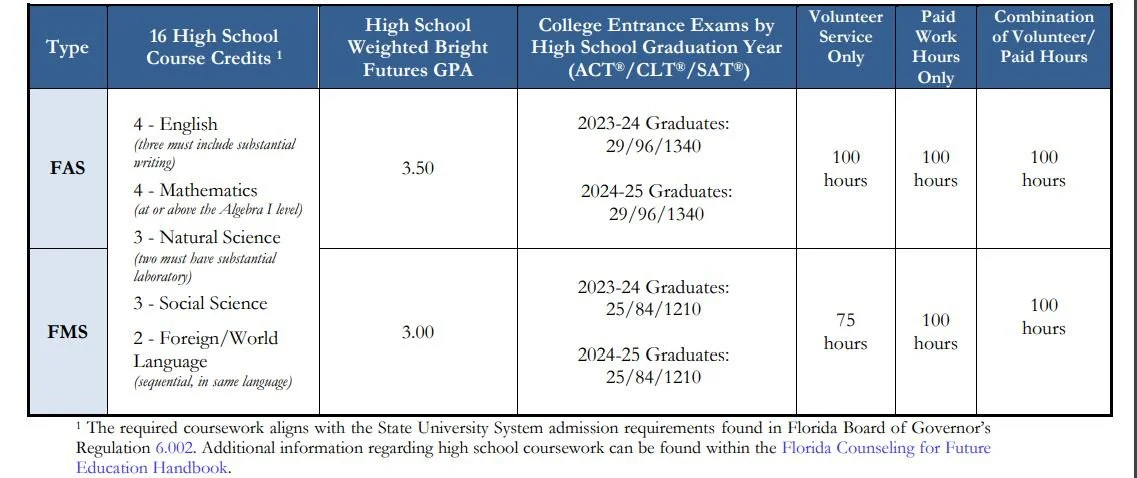
Image from Bright Futures Handbook
The FAS scholarship is the highest level available to students and covers 100% of tuition and applicable fees at Florida public institutions. If a student chooses to attend an eligible private institution, they are given a comparable amount which could add up to approx. $6000.
The FMS scholarship is the second tier and covers 75% of tuition and applicable fees or 100% of an associates degree. It also covers a comparable amount at eligible private institutions.
To apply for Bright Futures, students must first complete the Florida Financial Aid Application (FFAA). This application typically opens on October 1 and must be completed by August 31 post graduation. After applying for the FFAA, the student will gain access to complete the Bright Futures application.
Students can send their test scores by simply requesting an official test score to be sent to any of the 12 Florida sate universities, state colleges or public high schools. Students have until August 31 post graduation to meet the testing requirements, which means completing testing by June 30. Scores can be superscored and students can take it as many times as needed to get the minimum required scores. Students can bypass the test score requirements if they complete an AICE or IB Diploma.
Service and work hours must be completed by high school graduation. To verify what activities meet the service hour requirements, students should speak to their high school counselors. Whatever the activity may be, the student must get the signed verification from the appropriate supervisor. Activities which typically count towards the service hours are volunteering for nonprofits, working on local political campaigns, or interning at local businesses. As of June 2022, paid work now counts towards the 100 hour requirement.
Students can complete their application any time after December, when they are able to officially enroll at one of the eligible post-secondary institutions. The funds will be distributed directly to the college. Students should ensure they keep their account updated with the institution they are attending as well as their service hours. They should also make sure their counselor sends their official transcripts.
Both levels of Bright Futures can be used for summer semester and depending on the college's programs, may be able to be used for study abroad. A common misconception is that the Bright Futures is a 'full ride'. However, it covers solely the tuition and some fees. unless a family has a 529. Families should not neglect to seek additional funding such as scholarships and other institutional and federal financial aid. Parents should follow all deadlines to file the FAFSA and CSS PROFILE where required in order to be eligible for other aid.
When families have a 529 Plan, the schools apply those funds first and then the Bright Futures. In this case, Bright Futures funds can be used for expenses other than standard tuition and fees. If there are funds left over, the school will usually give them back to the student to use for additional expenses.
Consider the requirements early as you go through high school and begin to complete the service hours, meet college prep course requirements, and prepare for standardized tests to ensure you do not miss out on these extra funds! Schedule a free consultation with us to discuss Bright Futures and your college search and applications.

College Planning Timeline for Juniors
Spring break is here and many high school juniors are FINALLY coming to the realization that it is time to focus on the college search. Here are my tips and timeline for juniors at any stage in the process. Start now!
Spring break is here and many high school juniors are FINALLY coming to the realization that it is time to focus on the college search. Here are my tips and timeline for juniors at any stage in the process. Start now!
1. Spend time researching college and career options
While many juniors have (hopefully) already done this, there are probably equally as many who have not. Most students have had a broad discussion of college plans with their parents and/or high school counselor. What they probably haven't done enough of is actually sit down and do some self reflecting and research. What are their potential career and course of study interests? What type of college do they envision for themselves? What are the requirements for admission to those colleges? They should make it a goal to spend time doing research now while they still have time to visit colleges when the semester is in full swing, prep for standardized tests, and plan summer activities to help them with their admission and final decision.
2. Establish college application timeline and goals NOW
Juniors should draft their timeline for college applications now. Although they may not have their 'list' narrowed down to the final few schools, it is not too early to establish personal deadlines for getting their applications done. The key is to set those deadlines early - take the potential college deadlines and move them back by 6-8 weeks! There can be a lot of unexpected delays, added requirements and other bumps along the college application road, and it is better to be done early than to risk an incomplete application. Students who do not stay organized or prepare early often forget to take into consideration the fact that there are pieces of the applications which are not in their hands. Recommendation letters, high school transcripts, and test scores are just a few examples of requirements which may not be sent directly by the student. Students need to give their counselors and recommenders plenty of time to complete their pieces.
3. Plan Productive Summer Activities
The value of a job shadow, volunteering, or internship for all high school students is often underestimated. There are many other benefits aside from building one’s resume. Students who are unsure of their college major or future career interests should research local companies and organizations where they can shadow or volunteer in the summer. Even a few hours or a week would be helpful for the student to get an idea of what actually goes on in a particular job beyond the standard descriptions read online. While most companies may not want to pay a high school student or don’t openly advertise unpaid internships or job shadows, students should not shy away from seeking them out. Many professionals are open to helping. Students should seek out opportunities for self-exploration and learning more about potential careers and majors before they apply for college and summer is the perfect time for this.

ACM College Consulting, LLC
For more tips check out these other great resources:
The College Essay Guy: https://www.collegeessayguy.com/blog/junior-february-whats-next
The College Board: https://secure-media.collegeboard.org/CollegePlanning/media/pdf/BigFuture-College-Planning-Calendar-Juniors.pdf

The Spring Scholarship Search
Searching for Scholarships can definitely begin earlier than senior year, but now is a perfect time for seniors to use their free time for searching and applying for scholarships. Many students ask me where to search and how to get the most money. Unfortunately, there is no single, simple answer.

Now that college applications are complete, it is a perfect time for HS seniors to use some of their free time for searching and applying for scholarships. There are also many scholarships for younger students, so non-seniors could benefit from dedicating some time to this too. Many students ask me where to search and how to get the most money. Unfortunately, there is no single, simple answer. There are scholarships everywhere just waiting to be found! Here are some tips for your search for the $$$.
Of course getting scholarships from your potential college is the first stop. You should have filled out the FAFSA and/or CSS Profile by now if you have applied to college. If you have not completed those financial aid applications, do it ASAP! Colleges use these forms for determining financial aid awards and much of it is awarded on a first come-first serve basis. You will see what your scholarship and aid awards are on your financial aid award letter which you will receive from your potential colleges before May 1. If you are a junior considering your options, remember to take a look at the academic scholarships and financial aid colleges offer before applying. Some of the scholarships require a separate application and may even have an earlier deadline than the regular college applications. You do not want to miss out on those.
There are so many scholarship search websites it is often overwhelming. Select just 2-3 and consistently check them for updates. Some of the to best pages are:
Fastweb - After signing up and completing a profile (yes, many pages require this), you will be able to search and get matched with their database of around 1.5 million scholarships. You are able to keep your scholarships organized by those you are not interested in, those you would like to apply for and those you have already applied for.
Scholarships.com - Scholarships.com updates their database of more than 3.5 million scholarships to be sure to only include legitimate, current scholarships. Similar to fastweb, you sign up and complete a profile to get matched with potential scholarships.
Consider the local opportunities before jumping into the small nationwide scholarships. Great scholarship resources can be local community organizations, student and parent employers, banks, churches, and companies. Most states also have their own form of scholarship or grant for residents, for example the PHEAA grant for PA residents, Florida Bright Futures, and Hope Scholarship in Georgia. Click on your state on this handy map and find out what is available. These can be very valuable resources and should not be overlooked. Some of these statewide programs such as Bright Futures require a certain GPA, test scores, and community service hours which need to be taken into consideration earlier than senior year.
Although it may seem daunting to have to write yet another essay for an application or fill out another form, it may end up being well worth your time. As someone recently pointed out to me, ‘if you spend 2 hours on an application and end up getting $1000, that is $500 an hour. Where else can you get that?’ Take some time and submit quality applications.
A final note of caution to those of you on the hunt for funds - beware of the websites which require payment for access to scholarship lists or people who guarantee they will get you scholarships. As you know by now, almost nothing in the college application world is a guarantee and you are capable of finding the scholarships on free websites.
Additional Resources
National Association of Student Financial Aid Administrators parent and student resources: https://www.nasfaa.org/students_parents_counselors
Read more about scholarship scams here: https://www.consumer.ftc.gov/articles/0082-scholarship-and-financial-aid-scams
SWFL Scholarships