
My Visit to Luiss Guido Carli University












I’m still thinking about my three days at the Luiss Guido Carli University Counselor Fly-in in Rome!
The campuses are beautiful. From the gardens at Viale Romania to the historic setting of Viale Pola and Villa Blanc, Luiss has a real sense of place. I was continuously amazed by each of the campuses and the stories behind them. But what I’ll remember most is the exciting feeling between classes: students and faculty chatting, sitting outside enjoying the sunshine, and speaking in various languages. Whether they were grabbing an espresso between classes, sitting in lectures, or hanging out in the welcoming Luiss Language Cafe, everyone looked genuinely happy to be there.
I loved learning more about the English-taught undergraduate programs, including Politics, Philosophy and Economics (PPE), Economics and Business, Business Administration, Global Law, and Management and Artificial Intelligence. I was impressed by Luiss’s dedication to internationalization and the way it is keeping pace with technology and AI. With around 8,500 undergraduates and 19% international students, Luiss feels both lively and globally connected. The 1:7 faculty-to-student ratio and 96% on-time graduation rate also stood out to me. The double- and triple-degree opportunities were another highlight, with partners including Sciences Po and George Washington University offering exciting possibilities for studying across countries.
What really stood out was the emphasis on helping students connect what they learn in class with the world beyond campus. Hearing about opportunities to learn from professionals—and meeting experienced faculty who were so passionate about their subjects and the school—gave me a much better feel for the education Luiss offers.
And then there were the other counselors! One of my favorite parts of a fly-in is swapping stories and questions with people who work with students all over the world, and it was great to reconnect with many of my IECA Independent Educational Consultants Association colleagues! I came away with new connections, pages of notes, and a much better sense of which of my students might thrive at Luiss. After years of reading about Luiss online and speaking with their counselors, it was great to finally see it for myself.
A big thank you to the Luiss team for such a warm welcome, and to my fellow counselors for making the conversations as memorable as the visit. What a lovely few days in Rome!

Are U.S. Expats Considered International Students?

At most U.S. universities, citizenship—not where a student lives or attends school—determines whether the applicant is classified as domestic or international. However, your application is often read with the international applications.
At most colleges, your application will be read by the international admissions team responsible for your region and more familiar with the school curricula and other aspects related to student life in that area. It makes sense that your application would be read in the context of where you are attending school. You would be compared more to the students in your region. However, when it comes down to choosing an expat vs a true international student, you often have the advantage as you are eligible for federal aid and do not have the burden of providing proof of finances or eligibility for visa. New policies limiting visa periods and suggested caps on international students would not apply to U.S. expats as they have citizenship.
Although you are not an ‘international student’, you have the benefit of the international experience and hopefully language skills you have gained while living outside of the US. These are great assets to highlight in your applications. How has your international experience shaped you? What can you bring from this to your future campus? I help guide my students to focus on and add activities to their resume which will enhance their application and demonstrate their uniqueness. We also find creative ways to include these international experiences in their essays.
See other posts in U.S. expat college consulting series
Update on original article posted in 2024
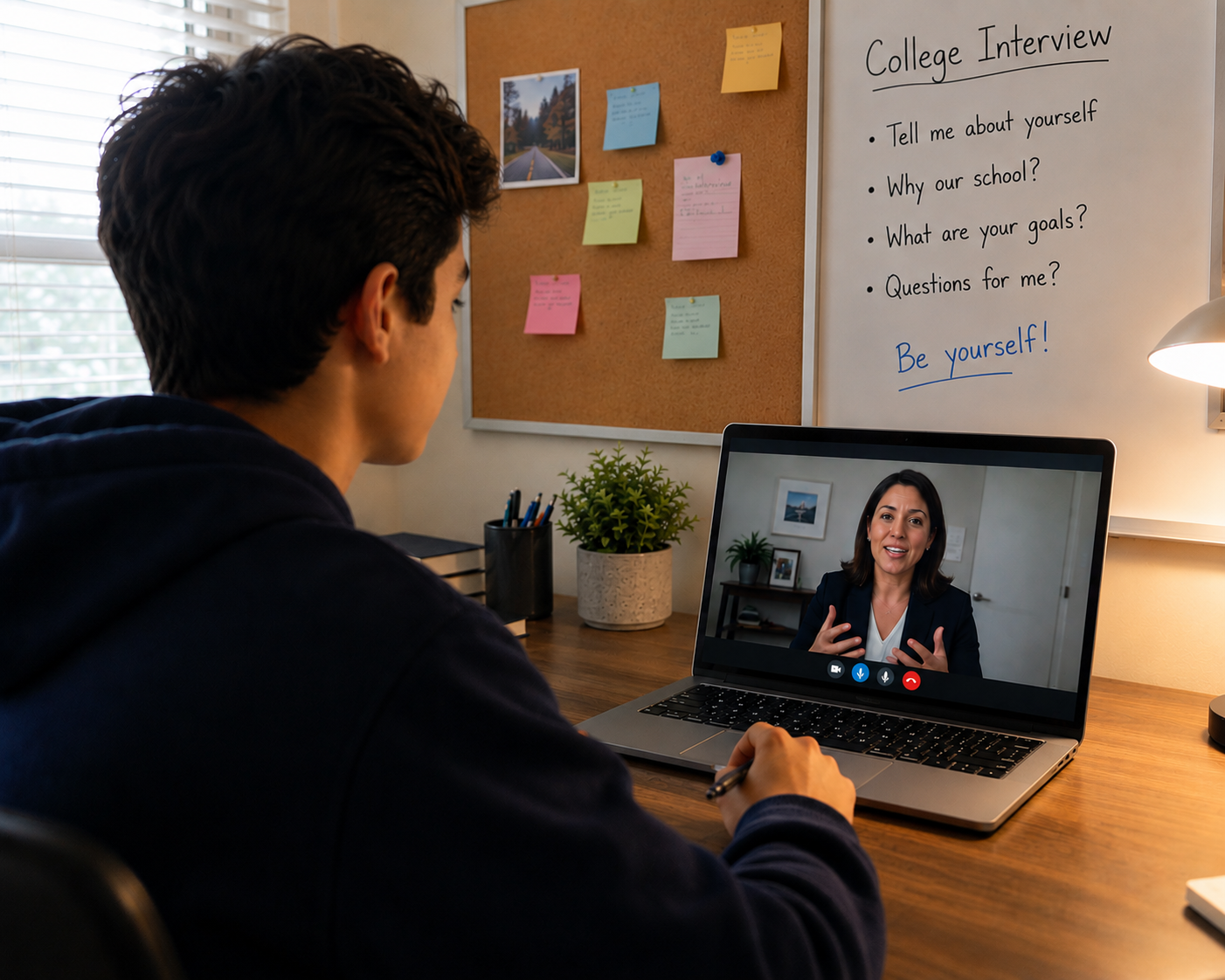
College Admissions Interviews: A Guide for International Students
.S. college admissions interviews are one of the most misunderstood aspects of the admissions process for international students.
With every university following its own policies, it can be difficult to know which opportunities matter and whether completing an interview will strengthen your application. Whether an interview is worth your time and investment depends on your college list, where you're applying from, and whether the interview will add something meaningful to your application.
Here's what every international applicant should know.
U.S. college admissions interviews are one of the most misunderstood aspects of the admissions process for international students.
With every university following its own policies, it can be difficult to know which opportunities matter and whether completing an interview will strengthen your application. Whether an interview is worth your time and investment depends on your college list, where you're applying from, and whether the interview will add something meaningful to your application.
Here's what every international applicant should know.

Do International Students Have to Interview for U.S. Colleges?
The short answer is no.
Most U.S. colleges do not require interviews for international undergraduate applicants. Instead, colleges may offer or accept one of three interview options:
An interview with an admissions officer
An interview with an alumni volunteer
A third-party interview through InitialView or Vericant
Colleges such as MIT and Harvard offer interviews to as many students as possible, while most colleges don't offer interviews at all. Some colleges, such as Brown, offer students the opportunity to submit their own video introductions instead. Others, such as Bennington, will send an interview request if they would like to ask additional questions.
Even when interviews are available, they're usually considered optional or recommended, rather than required.
That's why it's important to understand each college's policy before deciding whether to schedule one.
Why Do Colleges Offer Interviews?
For international applicants, interviews give admissions officers another opportunity to get to know the person behind the application. They help colleges understand:
Your communication style and level of English proficiency
Your academic and extracurricular interests
Your motivation for studying in the U.S.
Your personality and intellectual curiosity
Admissions officers are not looking for perfect English or memorized answers. They're looking for thoughtful, authentic conversations.
The Three Types of Interviews
Alumni Interviews - Many selective colleges offer interviews with alumni volunteers. These conversations are typically informal and focus on your interests, goals, and reasons for applying.
Admissions Interview - Some colleges offer interviews directly with members of the admissions office. These are usually conducted virtually and may be slightly more evaluative than alumni interviews.
InitialView and Vericant - When alumni or admissions interviews aren't available, many colleges accept third-party interviews through InitialView or Vericant. Instead of interviewing separately for multiple universities, you complete one professional interview that can be shared with participating colleges.
Both platforms include:
A live interview
Questions about your academics and activities
A recording that colleges can review
A proctored writing sample -students respond to a prompt in 20-30 min.
InitialView vs. Vericant
Families often ask me which platform is better. The truth is that neither is universally better. The right choice depends on the colleges you're applying to and which platform they recommend. Always check the admissions website for each college on your list before scheduling an interview. A big difference between the two platforms is that InitialView’s interview is more conversational, while Vericant is more structured and includes a picture description. Vericant provides colleges with a score of your English skills (Spoken English Evaluation), while InitialView does not.
Should You Complete One?
This is where personalized advice matters. I don't recommend interviews simply because they're available. Instead, we consider questions such as:
Will colleges actually review InitialView or Vericant?
Will the interview strengthen your application?
Are you comfortable communicating in English in an interview setting?
Is the cost worthwhile for your college list?
For some students, an interview is an excellent opportunity to showcase their personality and communication skills. For colleges that offer alumni or admissions interviews, you have an opportunity to demonstrate your interest in the school while allowing them to get to know you better.
Every student's application strategy should be individualized.
Tips for a Successful Interview
The strongest interviews don't come from students who memorize answers.
Instead:
Be prepared, but conversational
Share stories rather than reciting your résumé
Let your curiosity and enthusiasm come through
Don't be afraid to pause before answering a question
Admissions officers want to meet the real you—not a rehearsed version of you.
Final Thoughts
A college interview won't determine your admission on its own. But when used strategically, it can help admissions officers better understand the thoughtful, motivated student behind the application.
At ACM College Consulting, I help students develop an admissions strategy that reflects their individual strengths—not a one-size-fits-all checklist. That means deciding whether an InitialView or Vericant interview is worthwhile, preparing for alumni or admissions interviews, and helping students communicate their stories with confidence and authenticity.
If you're applying to U.S. colleges from abroad and aren't sure whether an interview should be part of your admissions strategy, I'd love to help. Together, we can build an application that highlights not only what you've accomplished, but who you are.
Notes:
Some schools such as Claremont McKenna prefer InitialView
Harvard and Duke are two of the schools which offer alumni interviews to many students, but not all. It is based on interviewer availability. If offered, they highly recommend you do it.
Georgetown requires an interview unless they are not offered in your region. They will provide you with the contact information for an interviewer in your area if available. Then, it is your responsibility to contact them and schedule the interview.

A Week in My Life as a College Consultant

People often assume that college consulting is all about applications and essays. While those are certainly important, they are only one piece of a much bigger picture. A typical week in my work involves supporting students at every stage of their educational journey, from 9th graders just beginning to think about university plans to graduates preparing for their next chapter. No two weeks are ever the same.
This week, I helped a sophomore create her first resume, which gave us a complete picture of her activities and accomplishments and helped us identify opportunities to deepen her interests, build meaningful experiences, and clarify her academic and career goals over the coming years. I love getting to know my students better through this process and helping them uncover what they genuinely enjoy, what sparks their curiosity, and where they may want to focus their energy in the future.
I also worked with graduating seniors who are preparing for university this fall. Together, we explored housing options in the UK and the Netherlands, compared costs and locations, and continued searching for additional scholarship opportunities. My work doesn't end once a student chooses a university—I continue to support them through the transition, helping them prepare for a successful start to this exciting new chapter.
For my rising seniors applying to U.S. universities, application season is already underway. We have begun brainstorming Common App essays, refining activity descriptions, finalizing last testing plans, and working on application strategies that highlight their unique stories. Beyond applications, I helped several students plan campus visits across Europe and the United States.
Outside of student meetings, you'll find me touring campuses, attending webinars, and connecting with colleagues across the admissions world. As an active member of the Higher Education Consultants Association and the Independent Educational Consultants Association, I have the opportunity to exchange ideas and insights with other consultants and admissions professionals on a daily basis. I am constantly learning, and being part of these professional communities helps me bring the latest information and best practices to the students and families I work with. Staying current is a must!
College consulting is about much more than helping with applications. It's about supporting thoughtful planning and informed decision-making, and helping students build a path that is right for them. That's the work I have the privilege of doing every day.
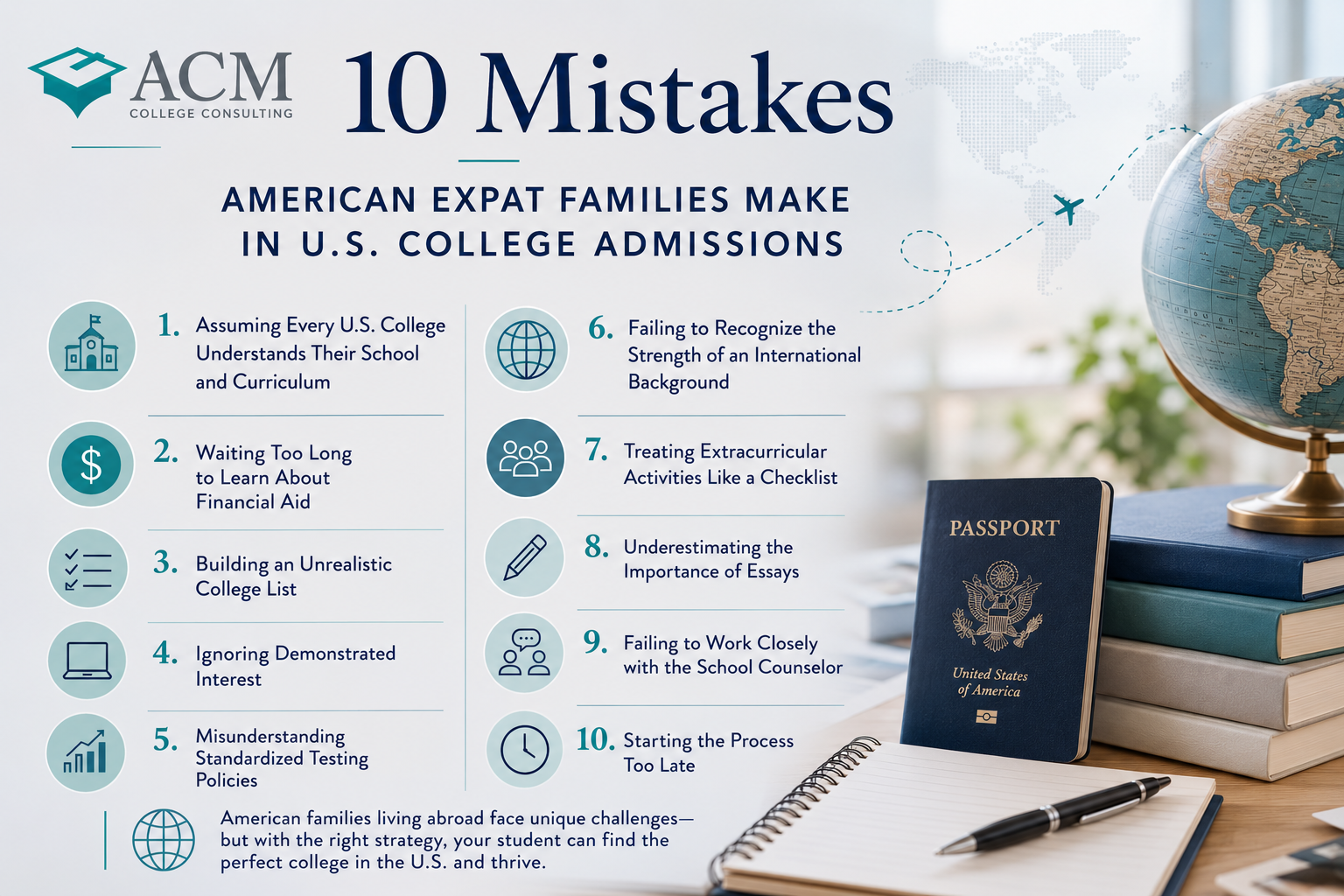
10 Mistakes American Expat Families Make in U.S. College Admissions
For American families living abroad, applying to college in the United States can feel like navigating two educational systems at once. Many students attend international schools, follow the IB, A-Levels, or other national curricula, and may have spent years outside the U.S. before beginning the college admissions process.
As a college admissions counselor who works with American students living overseas, I've seen many families make the same avoidable mistakes. With early planning and a clear understanding of how U.S. colleges evaluate applicants from international schools, these mistakes can be avoided.
Here are ten of the most common mistakes American expat families make—and how to avoid them.
1. Assuming Every U.S. College Understands Their School and Curriculum
Many American families living abroad assume that admissions officers automatically understand their student's school, grading system, and curriculum.
In reality, admissions officers review applications from thousands of schools around the world. While they are experienced in evaluating applicants from a variety of educational backgrounds, they may not be familiar with the specific opportunities, grading practices, course offerings, or academic culture at every international school. Families sometimes assume that strong grades alone tell the whole story, when colleges are also trying to understand the context in which those grades were earned.
Students who fail to provide appropriate context may miss opportunities to help admissions officers fully appreciate the rigor of their academic program and the uniqueness of their educational experience.
What to do instead: Make sure colleges receive a complete picture of your student's academic environment through the school profile, counselor report, course selection, and application materials. Students should understand how their curriculum is viewed in U.S. admissions and be prepared to explain aspects of their educational experience.
2. Waiting Too Long to Learn About Financial Aid
One of the biggest misconceptions among expat families is that financial aid planning can wait until senior year.
In reality, families should begin researching financial aid policies well before applications are submitted. U.S. citizens living abroad typically still qualify for federal aid, institutional grants, and merit scholarships, but documentation requirements can differ depending on residency status, tax filings, and family circumstances.
I've written extensively about the importance of understanding financial aid policies early in the process because affordability should be part of building a college list—not an afterthought. Families should understand the differences between need-based aid, merit scholarships, and how financial need can affect admissions decisions. (Read: Financial Aid for American Expats)
What to do instead: Research financial aid policies during sophomore or junior year and create a financially balanced college list.
3. Building an Unrealistic College List
Many students focus exclusively on highly selective universities.
Recent admissions cycles have become increasingly competitive, with acceptance rates at many well-known institutions remaining historically low. Even exceptionally qualified students are being denied admission at colleges that may have admitted similar applicants a decade ago.
Families living abroad often have less exposure to the breadth of excellent American universities and may underestimate the number of strong-fit institutions available.
What to do instead: Create a balanced list that includes likely, target, and reach schools, while considering academic fit, finances, and campus culture. Families who begin researching colleges during junior year are better positioned to build thoughtful and realistic lists rather than relying solely on rankings. (Read: U.S. College Application Timeline for International Students)
4. Ignoring Demonstrated Interest
At many colleges, demonstrated interest continues to play a role in admissions decisions.
Students living overseas sometimes assume that distance excuses them from engaging with colleges. However, admissions offices increasingly provide virtual information sessions, webinars, student panels, and online campus tours.
What to do instead: Attend virtual events, research local college fairs, connect with admissions representatives, and show genuine engagement with colleges on your list.
5. Misunderstanding Standardized Testing Policies
The testing landscape continues to evolve.
While many colleges remain test-optional, recent admissions cycles have shown a growing number of students submitting scores and several highly selective institutions reinstating testing requirements. Families should evaluate testing policies school by school rather than assuming scores no longer matter. For a deeper look at current testing trends and strategies, see What International Students Need to Know About SAT/ACT Testing in 2026. Also, do not ignore English proficiency requirements, as some colleges still require testing despite U.S. citizenship and attending an English-speaking high school. Testing should not be last minute, plan ahead!
What to do instead: Stay informed about each college's current testing policy and develop a testing strategy that aligns with your student's strengths and goals.
6. Failing to Recognize the Strength of an International Background
Many American families living abroad focus on what their student may be missing compared to peers in the United States.
Instead, they should recognize the unique strengths that come from an international upbringing. Students who have attended international schools, lived in multiple countries, learned additional languages, or adapted to different cultures often bring valuable perspectives to college campuses.
The mistake occurs when students fail to connect these experiences to their applications in a meaningful way. Admissions officers cannot appreciate experiences that are never explained or reflected upon.
What to do instead: Help your student think critically about how their international experiences have shaped their identity, interests, and goals. These experiences can become a powerful part of their application narrative.
7. Treating Extracurricular Activities Like a Checklist
Families often worry that students need a long list of activities to compete. However, colleges increasingly value meaningful engagement, leadership, initiative, and impact over sheer quantity.
For expat students, international experiences often provide unique opportunities for cross-cultural leadership, language development, community engagement, and global perspective.
What to do instead: Focus on depth, commitment, and authentic interests rather than accumulating activities.
8. Underestimating the Importance of Essays
Many students view essays as a final step in the process.
In reality, essays are often where students distinguish themselves from other highly qualified applicants. This is especially true for students from international schools, whose global experiences can provide compelling perspectives when presented thoughtfully.
The strongest essays are reflective, personal, and authentic—not travel journals or lists of accomplishments.
What to do instead: Begin brainstorming early and allow time for multiple revisions.
9. Failing to Work Closely with the School Counselor
Many American families living abroad focus heavily on essays, testing, and college lists while overlooking an important partner in the application process: the school counselor.
At most U.S. colleges, the counselor plays an important role in helping admissions officers understand a student's academic background and school context. Yet many students don't meet with their counselor until application deadlines are approaching, leaving little time to discuss application plans or gather required documents.
For students attending international schools, counselor-provided materials are especially important because admissions officers may be unfamiliar with the school's curriculum, grading system, course offerings, or university placement history.
Common documents that may be required include:
Official transcripts
Mid-year report
Counselor recommendation or Counselor Report
School Profile
Predicted grades (for IB, A-Level, and other international curricula)
Secondary School Report
Missing or delayed documents can create unnecessary stress and, in some cases, jeopardize application deadlines.
What to do instead: Build a relationship with your school counselor early in the process. Understand your school's procedures, request deadlines, and required documents well before senior year. Students should know exactly how transcripts, counselor reports, recommendations, and school profiles will be submitted to colleges and ensure there is plenty of time for processing before application deadlines. If the school does not have a counselor, it is important to find out who at the school can assist with this and how you can submit these materials to the colleges.
10. Starting the Process Too Late
Perhaps the biggest mistake of all is waiting until senior year to begin planning.
Strong college applications are built over time. Academic choices, extracurricular involvement, testing plans, college research, and financial aid preparation all become more manageable when students begin planning in grades 9–11. Families looking for a roadmap can review my U.S. College Application Timeline for International Students for a year-by-year breakdown of the process. Course selection, extracurricular involvement, testing plans, financial aid preparation, and college research all benefit from early strategy.
Students who begin planning during ninth or tenth grade typically have more flexibility, less stress, and stronger outcomes than those who rush the process in senior year.
What to do instead: Begin thinking about college planning as a multi-year process rather than a senior-year project.
Final Thoughts
American families living abroad face unique challenges in the college admissions process, but they also bring extraordinary strengths. Students who have lived internationally often develop adaptability, independence, cultural awareness, and global perspectives that can enrich college communities.
The key is understanding how U.S. colleges evaluate applicants from international schools and avoiding common misconceptions that can derail an otherwise strong application.
With thoughtful planning, realistic expectations, and a strategic approach, American expat students can successfully navigate the admissions process and find colleges where they will thrive.
If your family is living abroad and preparing for U.S. college admissions, starting early can make all the difference.

What International Students Need to Know About SAT/ACT Testing in 2026
In my work with international students and globally mobile families, testing policies are one of the most common areas of confusion in the U.S. admissions process. Over the past several years, standardized testing policies in U.S. college admissions have changed dramatically. Many universities moved to test-optional policies during the pandemic, leaving families wondering whether SAT or ACT scores still matter. Although many universities still maintain test-optional policies, some selective institutions such as Stanford, Penn, and Harvard have begun reinstating SAT or ACT requirements. At the same time, more students are choosing to submit scores, even when testing is optional.
Although many universities continue to offer test-optional admissions, recent data suggests that standardized testing is regaining importance in an increasingly competitive application landscape.
Are U.S. Colleges Requiring the SAT or ACT Again?
Some are.
A growing number of universities have begun reinstating testing requirements, particularly more selective institutions. Others continue to use test-optional policies, meaning students can choose whether or not to submit scores.
However, “test-optional” does not necessarily mean “test-irrelevant.”
This distinction is especially important for international students.
In many cases, strong SAT or ACT scores can still strengthen an application, particularly for students applying from:
unfamiliar educational systems
countries where grading systems are difficult to compare internationally
systems focused heavily on final exams
Test scores can help provide additional academic context.
What Happened During the 2025–26 Application Cycle?
The latest Common App data revealed several important trends:
Applications increased 5% year-over-year
The average student submitted 6.59 applications
First-generation applicants increased by 13%
International applications decreased by 9%
One of the most notable shifts involved standardized testing.
Although only around 5% of Common App institutions currently require SAT or ACT scores, the number of students submitting test scores increased substantially this year.
Nearly 784,000 students submitted test scores during the 2025–26 cycle — an 11% increase from the previous year.
This marked the first time since before the pandemic that more students applied with test scores than without. The trend suggests that many applicants increasingly believe strong scores may still strengthen an application — even at test-optional schools.
Why Are More Students Submitting Scores Again?
There are several likely reasons.
Increased Competition
Application numbers continue to rise, especially at selective universities. As more students apply to more schools, applicants are looking for additional ways to distinguish themselves academically.
Greater Clarity Around Testing
In the early years of test-optional admissions, many students were uncertain whether scores truly mattered. Now, several admissions cycles later, families and counselors have more data. It has become increasingly clear that submitting strong scores can strengthen an application.
New ACT Changes International Students Should Know About
The ACT has changed significantly over the past year. It is much shorter, now taking closer to two hours instead of three. One of the biggest changes is that the ACT Science section is now optional.
Under the new format:
the composite ACT score will be based only on English, Math, and Reading
students who choose to take Science will receive a separate Science score and STEM score
This has created some confusion because universities are still determining how they will evaluate the optional Science section.
At the moment, only a relatively small number of universities specifically require or recommend the ACT Science, although policies vary by institution and intended major. For students applying to STEM programs, taking the Science section may be worthwhile.
The ACT is only available in digital format outside of the U.S. Unlike the Digital SAT, however, it is not adaptive. All students still receive the same questions in the same order regardless of performance during the exam.
What This Means for Students
The changing testing landscape can make planning more complicated.
Students should pay close attention to:
whether universities require testing
whether ACT Science is recommended for intended majors
superscoring policies
scholarship requirements tied to testing
Should International Students Take the SAT or ACT?
The answer depends on the student, their academic profile, and the universities they are considering.
In general, testing may still be worth considering for students who:
are applying to highly selective universities
have strong testing ability
come from less familiar educational systems
want to strengthen academic comparability
are applying for merit scholarships
Students with weaker scores, however, may still benefit from applying test-optional at many institutions.
There is no universal answer.
Final Thoughts
The U.S. admissions landscape continues to evolve, and testing policies remain one of the most confusing areas.
While many universities still allow students to apply without scores, recent application trends suggest that more students submit them.
Testing strategy is never one-size-fits-all. In my work with students, testing strategy is always personalized based on the student’s academic profile, strengths, university goals, and the specific admissions policies of the schools they are considering.
Students planning ahead may also find my U.S. College Application Timeline for International Students helpful.
How International Students Apply to U.S. Colleges (Step-by-Step Guide 2026)
Applying to U.S. colleges as an international student can feel complex—but in my experience working with students and families around the world, the process becomes much more manageable once you understand the key steps and timeline.
Over the years, I’ve worked with both international students and U.S. families living abroad, and one of the biggest challenges I see is that the U.S. system is very different from what students are used to. This guide breaks down exactly how the process works—and how to approach it strategically.
What Is the U.S. College Application Process for International Students?
The U.S. college application process is a holistic review system, meaning universities evaluate more than just grades.
Most schools consider:
Academic performance (grades and course rigor)
Extracurricular activities
Personal essays (very different from the U.K. personal statement questions or European motivational statements)
Letters of recommendation
Standardized test scores (optional at many schools)
In other words, admissions is not just about how well you perform academically—it’s about how you present your overall profile.
What Do International Students Need to Apply to U.S. Colleges?
Most international applicants need the following:
High school transcripts
English proficiency test scores (depending on your school system)
SAT or ACT scores (optional at many schools)
Letters of recommendation
Personal statement and supplemental essays
Some universities may also require:
Financial documentation
Interviews (in some cases)
One thing I often emphasize to families is that these requirements are not just a checklist—the way each piece fits together is what ultimately shapes the application.
U.S. College Application Timeline for International Students
One of the most common mistakes I see is students underestimating how early they need to start. The strongest applications are built over several years, not just in the final few months.
Download a free PDF of our U.S. College Application Timeline for International Students
Grade 9 (Foundation Year)
Primary goal: Build a strong academic and extracurricular base
Focus on achieving strong grades from the beginning
Choose a rigorous curriculum
Explore extracurricular activities (sports, clubs, volunteering, other interests, career exploration)
Begin identifying areas of genuine interest (not just “resume building”)
Develop strong study habits and time management skills
Why this matters:
U.S. colleges review your full high school record. Students often assume only their final exams matter—but in the U.S. system, consistency over time is key.
Grade 10 (Exploration & Direction)
Primary goal: Start building a clear profile
Continue strong academic performance
Narrow extracurricular involvement (focus on depth, not breadth)
Begin developing commitment or leadership
Research the U.S. college system and types of institutions:
Liberal arts vs research universities
Consider fit factors:
Location, size, cost, academics, student life
Attend virtual information sessions and webinars
Why this matters:
This is where I often guide students to move from “trying everything” to showing direction
Grade 11 / Junior Year (Critical Planning Year)
Primary goals: Narrow down your college major/career interests, find colleges that are good fits for YOU, and position yourself as a competitive applicant
Academics & Testing
Take SAT/ACT (if applicable)
Take English proficiency tests (TOEFL/IELTS/Duolingo)
Plan for retakes if needed
College Research
Build an initial college list (reach, target, safety)
Research admissions requirements and financial aid policies
Engagement & Exploration
Attend college fairs and information sessions
Visit campuses (in person or virtually, if travel isn’t possible)
Define what you want in a college
Activities & Leadership
Deepen extracurricular involvement
Take on leadership roles or pursue independent projects
Summer Before Grade 12
This is one of the most important—and often underused—periods.
Finalize your college list
Begin brainstorming and drafting personal essays
Create a resume or activity list
Research financial aid and scholarship options
Students I work with who use this summer well are almost always in a much stronger position going into their senior year.
Grade 12 / Senior Year (Application Year)
Primary goal: Execute applications effectively and on time
Early Fall (Aug–Oct)
Finalize college list
Complete essay drafts
Request letters of recommendation
Create Common App account
Coordinate with your school counselor (or equivalent)
Fall (Sept–Dec)
Finalize and submit applications
Apply Early Action or Early Decision if appropriate
Submit all required documents
Financial Preparation (Critical Step)
Prepare proof of financial support:
Bank statements
Sponsor letters
Certification of finances forms
This is an area where I often see delays—planning ahead here is essential.
Winter (Jan–Feb)
Submit Regular Decision applications
Confirm all materials are received
Spring (March–April)
Review admissions decisions
Compare offers carefully
Late Spring (April–May)
Make final decision
Submit enrollment deposit
Begin visa process
How Is Applying to U.S. Colleges Different from Other Countries?
This is one of the most important mindset shifts.
There is no single entrance exam
Students apply to multiple (or all) colleges via Common App, but requirements still vary by university
Admissions decisions are based on multiple factors
Essays and extracurriculars play a major role
This is why strategy—and not just academic performance—matters so much.
Can International Students Get Financial Aid in the U.S.?
Yes, but it is limited.
Most universities are need-aware for international students
A small number are need-blind
Merit scholarships are more common than need-based aid
Applying for financial aid at many colleges can have a big impact on admissions decisions
For U.S. citizens living abroad:
You are typically considered a domestic applicant for financial aid purposes
You most likely qualify for federal financial aid
This is an area where planning early can significantly expand your options.
What Are Common Mistakes International Applicants Make?
Based on my experience working with students, the most common mistakes include:
Starting the process too late
Focusing only on grades and test scores
Not preparing essays early enough
Failing to plan for financial documentation
Applying without a clear strategy
Focusing only on top-ranked schools instead of building a balanced list
Final Thoughts
Applying to U.S. colleges as an international student requires more than just strong academics—it requires planning, strategy, and an understanding of how the system works.
The students who are most successful are those who start early, build a clear profile over time, and approach the process thoughtfully. the U.S., you’re not alone—and with the right approach, it becomes much more manageable.
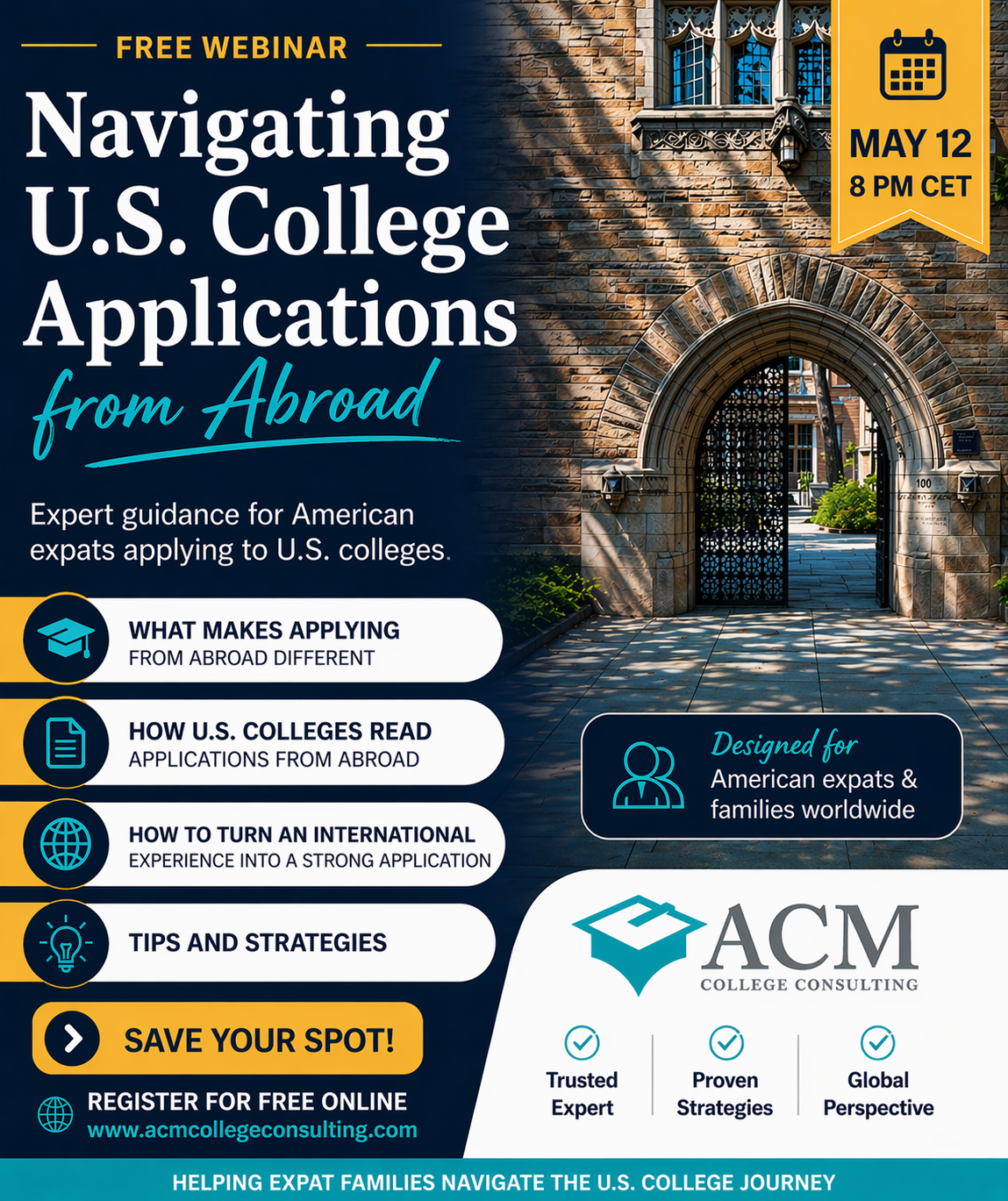
Free Webinar for U.S. Expats
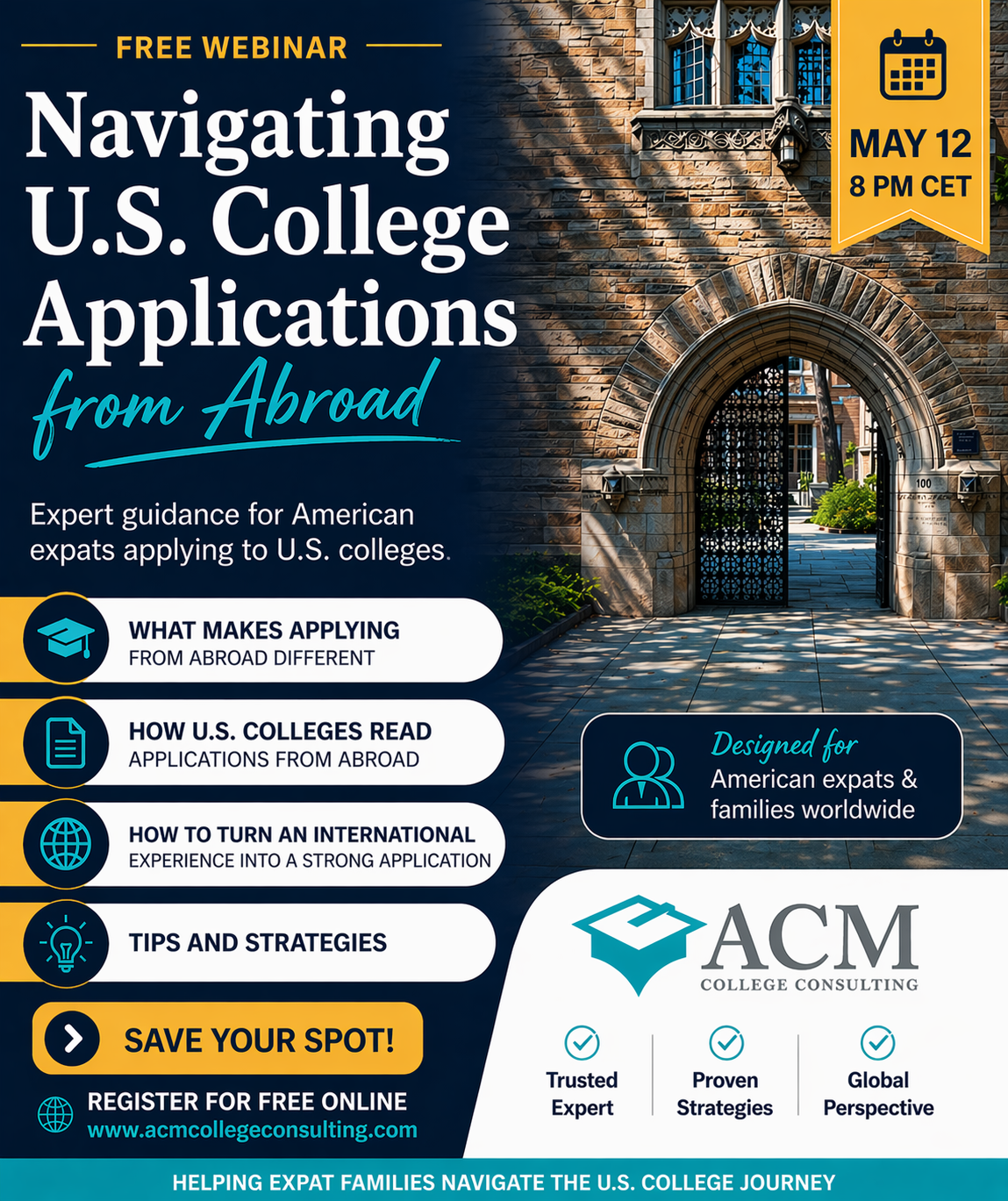
🎓 Thinking about applying to U.S. colleges from abroad?
We’re hosting a free webinar on May 12 at 8 PM CET to help families better understand the process and how to make applications stand out.
We’ll walk through:
✔️ What makes applying from abroad different
✔️ How U.S. colleges review applications from international students
✔️ How to turn a global experience into a strong application
✔️ Practical tips and strategies you can use right away
This session is designed for American expat students and families navigating the U.S. college journey.
👉 Save your spot today — it’s free: https://www.acmcollegeconsulting.com/
#StudyInUSA #CollegeAdmissions #ExpatsAbroad #FreeWebinar

College Consulting for American Families Living Abroad
If you’re an American family living overseas, planning for college can feel complicated.
Your student may attend an international school, follow a non-U.S. curriculum, and consider universities in several countries at once. At the same time, many families want to keep U.S. universities on the list. That means navigating different systems, timelines, essays, and application platforms depending on the country and university. It’s a lot.
My role is to make that process clearer, calmer, and more thoughtful for both students and parents.
Starting with the Student
Before we build a college list or start applications, I focus on getting to know the student.
What excites them?
What are they curious about?
What kind of academic environment will help them thrive?
The strongest applications come from students who understand themselves and can communicate their interests clearly. My role is to guide that process and help students present an authentic story in their applications.
A Global Perspective
Many of the families I work with live outside the United States or are considering universities in multiple countries. Having lived and worked in Europe for many years, I understand how different school systems and admissions expectations can be.
Students today may be considering universities in the U.S., the U.K., Canada, the Netherlands, or elsewhere—and each system works differently.
I help families make sense of those options so students can focus on finding the environment where they will thrive.
The Benefits of a Small, Personal Practice
College counseling is deeply personal work, and I believe students benefit from working closely with one advisor who truly knows them. I work directly with every student and family to:
Build real relationships with students
Understand each family’s priorities and concerns
Spend the time needed to think carefully about each application strategy
Be available when questions or anxieties inevitably arise
Finding the Right Fit
Of course, getting into college is exciting. But admissions decisions are just one moment in a much longer journey. What matters more is helping students find universities where they will grow, explore, and challenge themselves.
The goal isn’t simply admission—it’s finding the place where a student will truly belong.
Are you an American family living abroad starting the college planning process?
I specialize in working with expatriate families around the world to navigate U.S. and international university admissions. Schedule a free intro session, and I’d be happy to talk about how I work with students and families and answer your questions.
Learn more about my U.S. Expat College Counseling Services here

Financial Aid for International Students at U.S. Colleges
For many international students, the cost of studying in the United States can feel like the biggest obstacle. While financial aid for international students at U.S. colleges does exist, it’s important to understand how admissions and funding really work — especially when financial need is involved.
Do U.S. Colleges Offer Financial Aid to International Students?
Yes, many U.S. colleges provide institutional scholarships and financial aid for international students. The financial aid policies and amounts vary significantly from college to college and between state schools and private colleges. For example, public universities typically do not offer need-based aid and award limited merit aid, while private colleges offer more. It is important to research financial aid policies and availability at each college when building your list.
Need-Aware Admissions for International Students
Most U.S. colleges are need-aware for international applicants, meaning a student’s ability to pay can impact the admissions decision. In other words, applying for financial aid may make admission more competitive at many schools. Only a small number of U.S. colleges are truly need-blind for international students, which is why strategic school selection is critical. Schools that are need-blind and/or offer significant financial aid for international students are some of the most competitive for admission.
Types of Financial Aid Available
International students may receive:
Merit-based scholarships, awarded for academic achievement, leadership, or special talents
Need-based institutional aid, offered by colleges with budgets specifically for international students
Because funding is limited, students requesting significant financial aid must present especially strong academic profiles and applications.
Proof of Finances and the Student Visa Process
In addition to admissions, proof of financial resources is a required part of the U.S. student visa process. Students must show they can cover tuition and living expenses (through personal funds, scholarships, or a combination) in order to receive the Form I-20 and apply for an F-1 student visa. Here is a sample of what this form looks like. This makes understanding true affordability even more important early in the process.
Why Expert Guidance Matters
Navigating need-aware admissions, scholarships, and visa financial requirements can be overwhelming. At ACM College Consulting, we help international students:
Build realistic, financially strategic college lists
Understand how requesting aid affects admissions decisions
Identify schools that support international students with funding
Prepare strong applications and manage financial documentation
Financial aid for international students in the U.S. is possible — but it requires honest financial planning, careful school selection, and strong applications. With the right strategy and expert support, students can maximize both admission and funding outcomes while avoiding surprises during the visa process.
Stay tuned for our next blog post about financial aid forms for international students.