
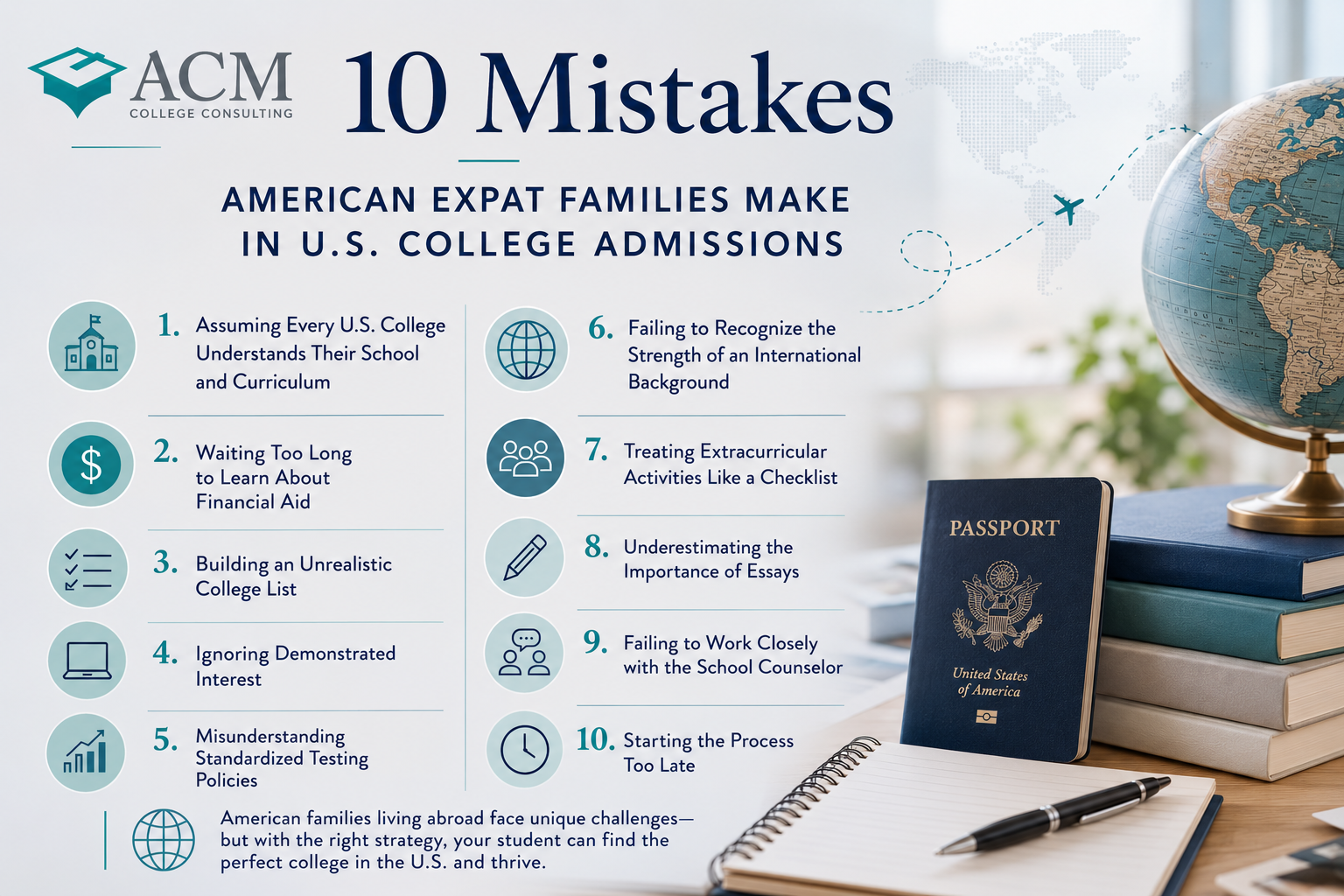
10 Mistakes American Expat Families Make in U.S. College Admissions
For American families living abroad, applying to college in the United States can feel like navigating two educational systems at once. Many students attend international schools, follow the IB, A-Levels, or other national curricula, and may have spent years outside the U.S. before beginning the college admissions process.
As a college admissions counselor who works with American students living overseas, I've seen many families make the same avoidable mistakes. With early planning and a clear understanding of how U.S. colleges evaluate applicants from international schools, these mistakes can be avoided.
Here are ten of the most common mistakes American expat families make—and how to avoid them.
1. Assuming Every U.S. College Understands Their School and Curriculum
Many American families living abroad assume that admissions officers automatically understand their student's school, grading system, and curriculum.
In reality, admissions officers review applications from thousands of schools around the world. While they are experienced in evaluating applicants from a variety of educational backgrounds, they may not be familiar with the specific opportunities, grading practices, course offerings, or academic culture at every international school. Families sometimes assume that strong grades alone tell the whole story, when colleges are also trying to understand the context in which those grades were earned.
Students who fail to provide appropriate context may miss opportunities to help admissions officers fully appreciate the rigor of their academic program and the uniqueness of their educational experience.
What to do instead: Make sure colleges receive a complete picture of your student's academic environment through the school profile, counselor report, course selection, and application materials. Students should understand how their curriculum is viewed in U.S. admissions and be prepared to explain aspects of their educational experience.
2. Waiting Too Long to Learn About Financial Aid
One of the biggest misconceptions among expat families is that financial aid planning can wait until senior year.
In reality, families should begin researching financial aid policies well before applications are submitted. U.S. citizens living abroad typically still qualify for federal aid, institutional grants, and merit scholarships, but documentation requirements can differ depending on residency status, tax filings, and family circumstances.
I've written extensively about the importance of understanding financial aid policies early in the process because affordability should be part of building a college list—not an afterthought. Families should understand the differences between need-based aid, merit scholarships, and how financial need can affect admissions decisions. (Read: Financial Aid for American Expats)
What to do instead: Research financial aid policies during sophomore or junior year and create a financially balanced college list.
3. Building an Unrealistic College List
Many students focus exclusively on highly selective universities.
Recent admissions cycles have become increasingly competitive, with acceptance rates at many well-known institutions remaining historically low. Even exceptionally qualified students are being denied admission at colleges that may have admitted similar applicants a decade ago.
Families living abroad often have less exposure to the breadth of excellent American universities and may underestimate the number of strong-fit institutions available.
What to do instead: Create a balanced list that includes likely, target, and reach schools, while considering academic fit, finances, and campus culture. Families who begin researching colleges during junior year are better positioned to build thoughtful and realistic lists rather than relying solely on rankings. (Read: U.S. College Application Timeline for International Students)
4. Ignoring Demonstrated Interest
At many colleges, demonstrated interest continues to play a role in admissions decisions.
Students living overseas sometimes assume that distance excuses them from engaging with colleges. However, admissions offices increasingly provide virtual information sessions, webinars, student panels, and online campus tours.
What to do instead: Attend virtual events, research local college fairs, connect with admissions representatives, and show genuine engagement with colleges on your list.
5. Misunderstanding Standardized Testing Policies
The testing landscape continues to evolve.
While many colleges remain test-optional, recent admissions cycles have shown a growing number of students submitting scores and several highly selective institutions reinstating testing requirements. Families should evaluate testing policies school by school rather than assuming scores no longer matter. For a deeper look at current testing trends and strategies, see What International Students Need to Know About SAT/ACT Testing in 2026. Also, do not ignore English proficiency requirements, as some colleges still require testing despite U.S. citizenship and attending an English-speaking high school. Testing should not be last minute, plan ahead!
What to do instead: Stay informed about each college's current testing policy and develop a testing strategy that aligns with your student's strengths and goals.
6. Failing to Recognize the Strength of an International Background
Many American families living abroad focus on what their student may be missing compared to peers in the United States.
Instead, they should recognize the unique strengths that come from an international upbringing. Students who have attended international schools, lived in multiple countries, learned additional languages, or adapted to different cultures often bring valuable perspectives to college campuses.
The mistake occurs when students fail to connect these experiences to their applications in a meaningful way. Admissions officers cannot appreciate experiences that are never explained or reflected upon.
What to do instead: Help your student think critically about how their international experiences have shaped their identity, interests, and goals. These experiences can become a powerful part of their application narrative.
7. Treating Extracurricular Activities Like a Checklist
Families often worry that students need a long list of activities to compete. However, colleges increasingly value meaningful engagement, leadership, initiative, and impact over sheer quantity.
For expat students, international experiences often provide unique opportunities for cross-cultural leadership, language development, community engagement, and global perspective.
What to do instead: Focus on depth, commitment, and authentic interests rather than accumulating activities.
8. Underestimating the Importance of Essays
Many students view essays as a final step in the process.
In reality, essays are often where students distinguish themselves from other highly qualified applicants. This is especially true for students from international schools, whose global experiences can provide compelling perspectives when presented thoughtfully.
The strongest essays are reflective, personal, and authentic—not travel journals or lists of accomplishments.
What to do instead: Begin brainstorming early and allow time for multiple revisions.
9. Failing to Work Closely with the School Counselor
Many American families living abroad focus heavily on essays, testing, and college lists while overlooking an important partner in the application process: the school counselor.
At most U.S. colleges, the counselor plays an important role in helping admissions officers understand a student's academic background and school context. Yet many students don't meet with their counselor until application deadlines are approaching, leaving little time to discuss application plans or gather required documents.
For students attending international schools, counselor-provided materials are especially important because admissions officers may be unfamiliar with the school's curriculum, grading system, course offerings, or university placement history.
Common documents that may be required include:
Official transcripts
Mid-year report
Counselor recommendation or Counselor Report
School Profile
Predicted grades (for IB, A-Level, and other international curricula)
Secondary School Report
Missing or delayed documents can create unnecessary stress and, in some cases, jeopardize application deadlines.
What to do instead: Build a relationship with your school counselor early in the process. Understand your school's procedures, request deadlines, and required documents well before senior year. Students should know exactly how transcripts, counselor reports, recommendations, and school profiles will be submitted to colleges and ensure there is plenty of time for processing before application deadlines. If the school does not have a counselor, it is important to find out who at the school can assist with this and how you can submit these materials to the colleges.
10. Starting the Process Too Late
Perhaps the biggest mistake of all is waiting until senior year to begin planning.
Strong college applications are built over time. Academic choices, extracurricular involvement, testing plans, college research, and financial aid preparation all become more manageable when students begin planning in grades 9–11. Families looking for a roadmap can review my U.S. College Application Timeline for International Students for a year-by-year breakdown of the process. Course selection, extracurricular involvement, testing plans, financial aid preparation, and college research all benefit from early strategy.
Students who begin planning during ninth or tenth grade typically have more flexibility, less stress, and stronger outcomes than those who rush the process in senior year.
What to do instead: Begin thinking about college planning as a multi-year process rather than a senior-year project.
Final Thoughts
American families living abroad face unique challenges in the college admissions process, but they also bring extraordinary strengths. Students who have lived internationally often develop adaptability, independence, cultural awareness, and global perspectives that can enrich college communities.
The key is understanding how U.S. colleges evaluate applicants from international schools and avoiding common misconceptions that can derail an otherwise strong application.
With thoughtful planning, realistic expectations, and a strategic approach, American expat students can successfully navigate the admissions process and find colleges where they will thrive.
If your family is living abroad and preparing for U.S. college admissions, starting early can make all the difference.