
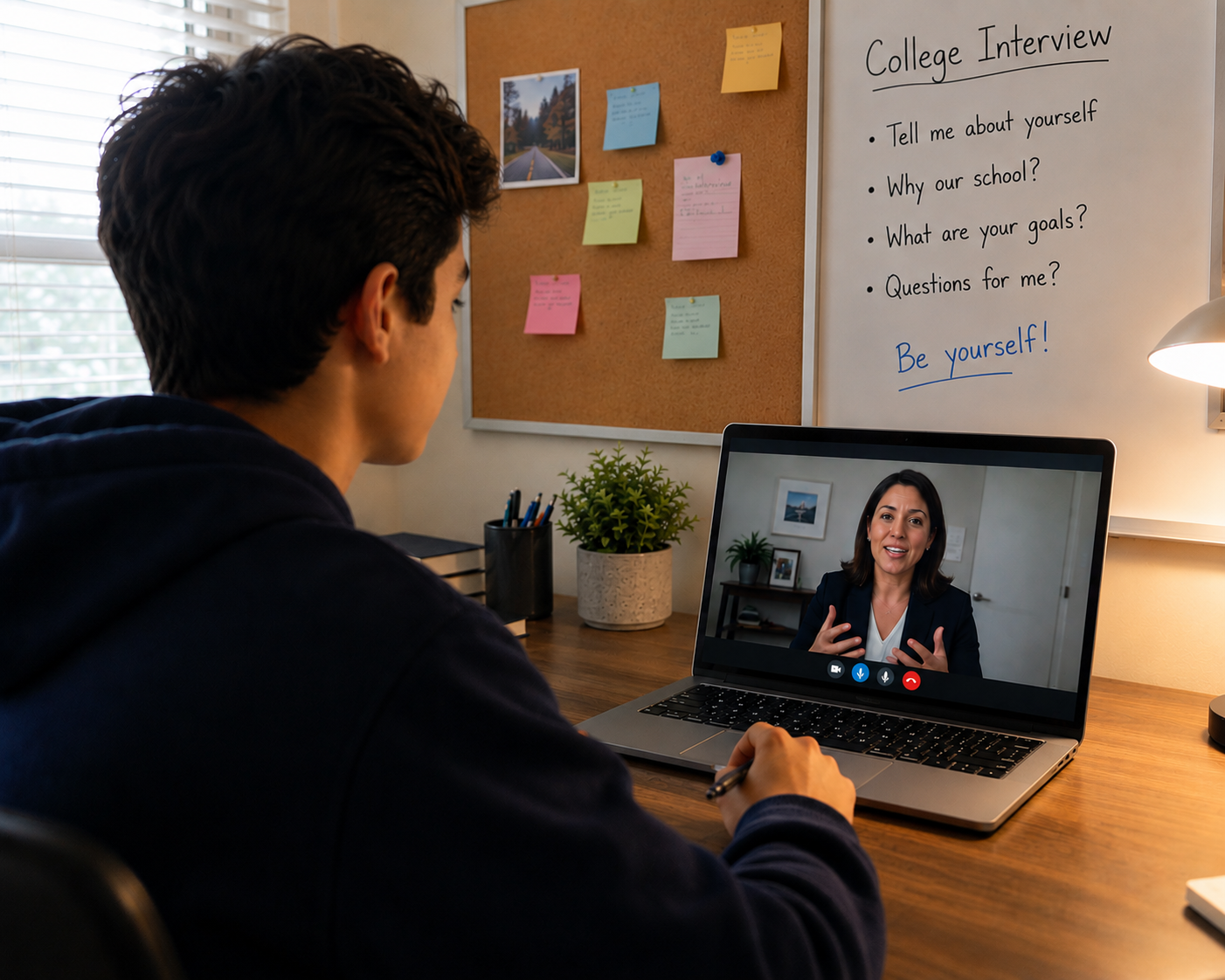
College Admissions Interviews: A Guide for International Students
.S. college admissions interviews are one of the most misunderstood aspects of the admissions process for international students.
With every university following its own policies, it can be difficult to know which opportunities matter and whether completing an interview will strengthen your application. Whether an interview is worth your time and investment depends on your college list, where you're applying from, and whether the interview will add something meaningful to your application.
Here's what every international applicant should know.
U.S. college admissions interviews are one of the most misunderstood aspects of the admissions process for international students.
With every university following its own policies, it can be difficult to know which opportunities matter and whether completing an interview will strengthen your application. Whether an interview is worth your time and investment depends on your college list, where you're applying from, and whether the interview will add something meaningful to your application.
Here's what every international applicant should know.

Do International Students Have to Interview for U.S. Colleges?
The short answer is no.
Most U.S. colleges do not require interviews for international undergraduate applicants. Instead, colleges may offer or accept one of three interview options:
An interview with an admissions officer
An interview with an alumni volunteer
A third-party interview through InitialView or Vericant
Colleges such as MIT and Harvard offer interviews to as many students as possible, while most colleges don't offer interviews at all. Some colleges, such as Brown, offer students the opportunity to submit their own video introductions instead. Others, such as Bennington, will send an interview request if they would like to ask additional questions.
Even when interviews are available, they're usually considered optional or recommended, rather than required.
That's why it's important to understand each college's policy before deciding whether to schedule one.
Why Do Colleges Offer Interviews?
For international applicants, interviews give admissions officers another opportunity to get to know the person behind the application. They help colleges understand:
Your communication style and level of English proficiency
Your academic and extracurricular interests
Your motivation for studying in the U.S.
Your personality and intellectual curiosity
Admissions officers are not looking for perfect English or memorized answers. They're looking for thoughtful, authentic conversations.
The Three Types of Interviews
Alumni Interviews - Many selective colleges offer interviews with alumni volunteers. These conversations are typically informal and focus on your interests, goals, and reasons for applying.
Admissions Interview - Some colleges offer interviews directly with members of the admissions office. These are usually conducted virtually and may be slightly more evaluative than alumni interviews.
InitialView and Vericant - When alumni or admissions interviews aren't available, many colleges accept third-party interviews through InitialView or Vericant. Instead of interviewing separately for multiple universities, you complete one professional interview that can be shared with participating colleges.
Both platforms include:
A live interview
Questions about your academics and activities
A recording that colleges can review
A proctored writing sample -students respond to a prompt in 20-30 min.
InitialView vs. Vericant
Families often ask me which platform is better. The truth is that neither is universally better. The right choice depends on the colleges you're applying to and which platform they recommend. Always check the admissions website for each college on your list before scheduling an interview. A big difference between the two platforms is that InitialView’s interview is more conversational, while Vericant is more structured and includes a picture description. Vericant provides colleges with a score of your English skills (Spoken English Evaluation), while InitialView does not.
Should You Complete One?
This is where personalized advice matters. I don't recommend interviews simply because they're available. Instead, we consider questions such as:
Will colleges actually review InitialView or Vericant?
Will the interview strengthen your application?
Are you comfortable communicating in English in an interview setting?
Is the cost worthwhile for your college list?
For some students, an interview is an excellent opportunity to showcase their personality and communication skills. For colleges that offer alumni or admissions interviews, you have an opportunity to demonstrate your interest in the school while allowing them to get to know you better.
Every student's application strategy should be individualized.
Tips for a Successful Interview
The strongest interviews don't come from students who memorize answers.
Instead:
Be prepared, but conversational
Share stories rather than reciting your résumé
Let your curiosity and enthusiasm come through
Don't be afraid to pause before answering a question
Admissions officers want to meet the real you—not a rehearsed version of you.
Final Thoughts
A college interview won't determine your admission on its own. But when used strategically, it can help admissions officers better understand the thoughtful, motivated student behind the application.
At ACM College Consulting, I help students develop an admissions strategy that reflects their individual strengths—not a one-size-fits-all checklist. That means deciding whether an InitialView or Vericant interview is worthwhile, preparing for alumni or admissions interviews, and helping students communicate their stories with confidence and authenticity.
If you're applying to U.S. colleges from abroad and aren't sure whether an interview should be part of your admissions strategy, I'd love to help. Together, we can build an application that highlights not only what you've accomplished, but who you are.
Notes:
Some schools such as Claremont McKenna prefer InitialView
Harvard and Duke are two of the schools which offer alumni interviews to many students, but not all. It is based on interviewer availability. If offered, they highly recommend you do it.
Georgetown requires an interview unless they are not offered in your region. They will provide you with the contact information for an interviewer in your area if available. Then, it is your responsibility to contact them and schedule the interview.
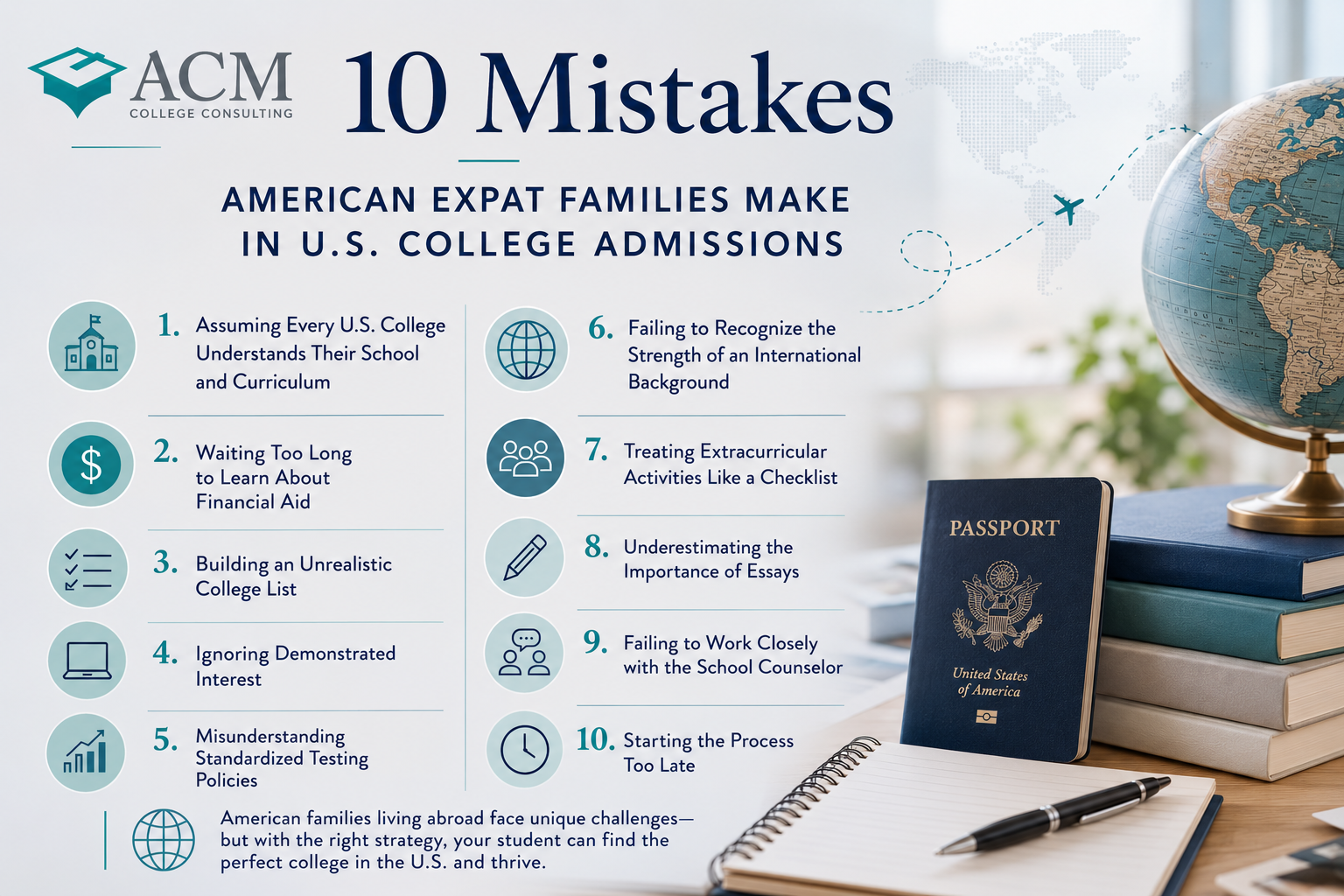
10 Mistakes American Expat Families Make in U.S. College Admissions
For American families living abroad, applying to college in the United States can feel like navigating two educational systems at once. Many students attend international schools, follow the IB, A-Levels, or other national curricula, and may have spent years outside the U.S. before beginning the college admissions process.
As a college admissions counselor who works with American students living overseas, I've seen many families make the same avoidable mistakes. With early planning and a clear understanding of how U.S. colleges evaluate applicants from international schools, these mistakes can be avoided.
Here are ten of the most common mistakes American expat families make—and how to avoid them.
1. Assuming Every U.S. College Understands Their School and Curriculum
Many American families living abroad assume that admissions officers automatically understand their student's school, grading system, and curriculum.
In reality, admissions officers review applications from thousands of schools around the world. While they are experienced in evaluating applicants from a variety of educational backgrounds, they may not be familiar with the specific opportunities, grading practices, course offerings, or academic culture at every international school. Families sometimes assume that strong grades alone tell the whole story, when colleges are also trying to understand the context in which those grades were earned.
Students who fail to provide appropriate context may miss opportunities to help admissions officers fully appreciate the rigor of their academic program and the uniqueness of their educational experience.
What to do instead: Make sure colleges receive a complete picture of your student's academic environment through the school profile, counselor report, course selection, and application materials. Students should understand how their curriculum is viewed in U.S. admissions and be prepared to explain aspects of their educational experience.
2. Waiting Too Long to Learn About Financial Aid
One of the biggest misconceptions among expat families is that financial aid planning can wait until senior year.
In reality, families should begin researching financial aid policies well before applications are submitted. U.S. citizens living abroad typically still qualify for federal aid, institutional grants, and merit scholarships, but documentation requirements can differ depending on residency status, tax filings, and family circumstances.
I've written extensively about the importance of understanding financial aid policies early in the process because affordability should be part of building a college list—not an afterthought. Families should understand the differences between need-based aid, merit scholarships, and how financial need can affect admissions decisions. (Read: Financial Aid for American Expats)
What to do instead: Research financial aid policies during sophomore or junior year and create a financially balanced college list.
3. Building an Unrealistic College List
Many students focus exclusively on highly selective universities.
Recent admissions cycles have become increasingly competitive, with acceptance rates at many well-known institutions remaining historically low. Even exceptionally qualified students are being denied admission at colleges that may have admitted similar applicants a decade ago.
Families living abroad often have less exposure to the breadth of excellent American universities and may underestimate the number of strong-fit institutions available.
What to do instead: Create a balanced list that includes likely, target, and reach schools, while considering academic fit, finances, and campus culture. Families who begin researching colleges during junior year are better positioned to build thoughtful and realistic lists rather than relying solely on rankings. (Read: U.S. College Application Timeline for International Students)
4. Ignoring Demonstrated Interest
At many colleges, demonstrated interest continues to play a role in admissions decisions.
Students living overseas sometimes assume that distance excuses them from engaging with colleges. However, admissions offices increasingly provide virtual information sessions, webinars, student panels, and online campus tours.
What to do instead: Attend virtual events, research local college fairs, connect with admissions representatives, and show genuine engagement with colleges on your list.
5. Misunderstanding Standardized Testing Policies
The testing landscape continues to evolve.
While many colleges remain test-optional, recent admissions cycles have shown a growing number of students submitting scores and several highly selective institutions reinstating testing requirements. Families should evaluate testing policies school by school rather than assuming scores no longer matter. For a deeper look at current testing trends and strategies, see What International Students Need to Know About SAT/ACT Testing in 2026. Also, do not ignore English proficiency requirements, as some colleges still require testing despite U.S. citizenship and attending an English-speaking high school. Testing should not be last minute, plan ahead!
What to do instead: Stay informed about each college's current testing policy and develop a testing strategy that aligns with your student's strengths and goals.
6. Failing to Recognize the Strength of an International Background
Many American families living abroad focus on what their student may be missing compared to peers in the United States.
Instead, they should recognize the unique strengths that come from an international upbringing. Students who have attended international schools, lived in multiple countries, learned additional languages, or adapted to different cultures often bring valuable perspectives to college campuses.
The mistake occurs when students fail to connect these experiences to their applications in a meaningful way. Admissions officers cannot appreciate experiences that are never explained or reflected upon.
What to do instead: Help your student think critically about how their international experiences have shaped their identity, interests, and goals. These experiences can become a powerful part of their application narrative.
7. Treating Extracurricular Activities Like a Checklist
Families often worry that students need a long list of activities to compete. However, colleges increasingly value meaningful engagement, leadership, initiative, and impact over sheer quantity.
For expat students, international experiences often provide unique opportunities for cross-cultural leadership, language development, community engagement, and global perspective.
What to do instead: Focus on depth, commitment, and authentic interests rather than accumulating activities.
8. Underestimating the Importance of Essays
Many students view essays as a final step in the process.
In reality, essays are often where students distinguish themselves from other highly qualified applicants. This is especially true for students from international schools, whose global experiences can provide compelling perspectives when presented thoughtfully.
The strongest essays are reflective, personal, and authentic—not travel journals or lists of accomplishments.
What to do instead: Begin brainstorming early and allow time for multiple revisions.
9. Failing to Work Closely with the School Counselor
Many American families living abroad focus heavily on essays, testing, and college lists while overlooking an important partner in the application process: the school counselor.
At most U.S. colleges, the counselor plays an important role in helping admissions officers understand a student's academic background and school context. Yet many students don't meet with their counselor until application deadlines are approaching, leaving little time to discuss application plans or gather required documents.
For students attending international schools, counselor-provided materials are especially important because admissions officers may be unfamiliar with the school's curriculum, grading system, course offerings, or university placement history.
Common documents that may be required include:
Official transcripts
Mid-year report
Counselor recommendation or Counselor Report
School Profile
Predicted grades (for IB, A-Level, and other international curricula)
Secondary School Report
Missing or delayed documents can create unnecessary stress and, in some cases, jeopardize application deadlines.
What to do instead: Build a relationship with your school counselor early in the process. Understand your school's procedures, request deadlines, and required documents well before senior year. Students should know exactly how transcripts, counselor reports, recommendations, and school profiles will be submitted to colleges and ensure there is plenty of time for processing before application deadlines. If the school does not have a counselor, it is important to find out who at the school can assist with this and how you can submit these materials to the colleges.
10. Starting the Process Too Late
Perhaps the biggest mistake of all is waiting until senior year to begin planning.
Strong college applications are built over time. Academic choices, extracurricular involvement, testing plans, college research, and financial aid preparation all become more manageable when students begin planning in grades 9–11. Families looking for a roadmap can review my U.S. College Application Timeline for International Students for a year-by-year breakdown of the process. Course selection, extracurricular involvement, testing plans, financial aid preparation, and college research all benefit from early strategy.
Students who begin planning during ninth or tenth grade typically have more flexibility, less stress, and stronger outcomes than those who rush the process in senior year.
What to do instead: Begin thinking about college planning as a multi-year process rather than a senior-year project.
Final Thoughts
American families living abroad face unique challenges in the college admissions process, but they also bring extraordinary strengths. Students who have lived internationally often develop adaptability, independence, cultural awareness, and global perspectives that can enrich college communities.
The key is understanding how U.S. colleges evaluate applicants from international schools and avoiding common misconceptions that can derail an otherwise strong application.
With thoughtful planning, realistic expectations, and a strategic approach, American expat students can successfully navigate the admissions process and find colleges where they will thrive.
If your family is living abroad and preparing for U.S. college admissions, starting early can make all the difference.

The Importance of the College List
Building a college list the student ‘loves’ and a balanced list is more important than ever. While it may be difficult to convince some students to add a few colleges they don’t consider ‘top’ or colleges they may not have heard of before, it is important to open their eyes to the options available to them. When I work with my students, I strive to help them create a list which goes beyond the obvious.
As of the end of January, the Common Application reported an increase in application volume of nearly 20% and an increase of 13% in the number of single applicants from the 2019-2020 application cycle. With the increase in number of applications due to reasons such as the ease of applying to more schools via the Common Application and more than 75% of colleges in the US now going test optional or test blind, it makes sense that the acceptance rates at some popular universities are going down. But how do you explain to a student with an excellent resume and top academics that they didn’t get in to a school they have worked towards for years?
The college admissions world comes with no guarantees. Every day, I hear stories from fellow counselors of top students getting turned down from schools they thought they were more than qualified for. But there are many factors considered beyond the basic application criteria often discussed such as the geography of the applicants, number of fellow applicants from the same high school, financial need, major applied to, demonstrated interest, predicted likelihood of a student enrolling if accepted, etc.
I recently lost a potential client because I would not ‘guarantee’ them admission to the schools they suggested to me. How could I ethically do so? While I can not guarantee admission to a certain university or the award of a certain scholarship, I can give my word that I will do my best and that includes helping students find additional schools which are great fits and helping them understand the factors to consider both within our control and beyond.
Building a college list the student ‘loves’ and a balanced list is more important than ever. While it may be difficult to convince some students to add a few colleges they don’t consider ‘top’ or colleges they may not have heard of before, it is important to open their eyes to the options available to them. When I work with my students, I strive to help them create a list which goes beyond the obvious. I have had many students apply to and/or end up attending schools they had not even heard of before working with me. It is an important part of my job to help them consider ALL options available to them and help them build a balanced list of schools – a list that is not ‘top heavy’, a list which includes schools who do not turn down more students than they accept. Most importantly, I help them build a list which includes schools where the student can be successful both socially and academically, a list of schools the student is truly happy with before they hit ‘submit’.
While reading the most recent article by Brennen Barnard, I was struck by the wisdom and optimism in some of the quotes such as this: “finding the college that will help one be successful isn’t a matter of gaining admission to X school, it’s a matter of going somewhere that can take you down the path to your goals and working hard when you get there.”…“admission is a door to a path and there is more than one door and more than one path. Getting an acceptance isn’t the ultimate goal and denial (or waitlist or deferral) isn’t the ending.”
Yes, it can certainly be frustrating and stressful, but there are so many wonderful options out there if you are willing to look and open your mind to the possibility of them. And if you plan ahead and build a solid list, you will find your place. More than half of colleges in the US accept more students than they turn down. Keep your head up!
Additional Articles to Consider:
https://www.collegeconfidential.com/articles/college-applications-in-2022/
https://www.collegedata.com/resources/the-facts-on-fit/understanding-college-selectivity
https://www.ppic.org/blog/college-admissions-in-an-era-of-uncertainty/

Tips to get your Essays Started
The college application essay has long been a valuable part of the admissions review process. Right behind academic performance which includes grades, rigor of curriculum and test scores, the essay(s) continue to be important. While this importance varies by the college you apply to, it is typically given more attention by private colleges. With many colleges becoming Test-Optional for the 2020-21 application cycle and beyond, the essay will most likely get more attention than in previous years.
The college application essay has long been a valuable part of the admissions review process. Right behind academic performance which includes grades, rigor of curriculum and test scores, the essay(s) continue to be important. While this importance varies by the college you apply to, it is typically given more attention by private colleges. With many colleges becoming Test-Optional for the 2020-21 application cycle and beyond, the essay will most likely get more attention than in previous years.
Some colleges simply require the common application personal statement, but many require supplemental essays tailored specifically to them as well. By now, almost all colleges have confirmed their supplemental essay topics, and the common application and coalition application prompts are out and ready to be tackled. Depending on your list of schools, you will most likely need to write more than one essay. So, if you have not gotten started by now, it is time! Here are my tips to kick off your personal statement:
Don't Focus on the Prompt – For the personal statement, think about YOUR story or something you really want to share and it will most likely fit. Don't forget there is always the Topic of Your Choice if what you end up choosing does not truly fit a prompt.
Be YOU – The goal is to help admissions get to know you and pretending to be someone you are not or someone you think they want you to be is not helping anyone. This is your chance to share something about you that can not be found anywhere else in the application or something that is really significant to you.
Start EARLY – The essay topics are out, why not begin now? For many students, the idea of sitting down to write such an important essay (or maybe any essay at all) seems daunting. However, delaying it is not going to make it any better. Starting early not only gives you more opportunity to write a quality essay, it also gives you time to really consider what you want to share with admissions. Some students end up writing several entirely different essays before they arrive at ‘the one’ they are happy with, and that takes TIME.
Brainstorm – You may have an idea or two in mind when you take a quick glance at the prompts, but it is time to dig deeper. Doing some excellent brainstorming activities can be really helpful for coming up with a good focus for your essay. I highly recommend the exercises from Ethan Sawyer, The College Essay Guy. His Essence Objects and Values exercises are great. If you are still drawing a blank, take a few days off and come back to it. But sometimes it takes actually sitting down and writing the first draft before you realize the essay topic will or won’t work. While it isn’t ideal, it is better to get rid of it before you spend too much time trying to make it into something it just can’t be.
Make it Personal and Entertaining – You want the readers to remember you after your essay and be able to connect you with YOUR story. You also want them to want to finish reading it. Give them details, use adjectives, don’t be repetitive, dig deep and you will be fine. Admissions readers get many essays on the same topic and sometimes on the most mundane subjects, but the way they were written turned them into something special. Ask anyone in admissions what their favorite essays were about and you may be surprised.
Get Feedback but not too Much - It is definitely a good idea to have someone read over your essay to check for grammatical errors and get an overall opinion. However, do not forget this is YOUR essay. Sometimes getting too many opinions ends up leaving you more confused than helped. Ask someone you trust for an honest opinion, triple check your grammar and be done!
Need some inspiration? There are many ‘successful’ essays out there for you to read. Take a look at a few of them and maybe it will spark an idea. Just remember, it is about YOU.
Resources:
https://www.collegeessayguy.com/blog/college-essay-examples
https://essaysthatworked.com/colleges?opt-out=true
https://apply.jhu.edu/application-process/essays-that-worked/
https://admissions.tufts.edu/apply/advice/past-essays/common-application-essays/
https://www.collegeessayguy.com/personal-statement
https://www.youtube.com/watch?time_continue=4&v=ZF4DErhsLvQ&feature=emb_logo
How to Research Colleges During a Pandemic
While much of this advice applies to researching schools any other time as well, it is particularly important for today’s students to understand the many ways they can learn about schools of interest outside of an official tour.

While much of this advice applies to researching schools any other time as well, it is particularly important for today’s students to understand the many ways they can learn about schools of interest outside of an official tour. Many students are building college lists without having the opportunity to visit the schools, but they are not taking the time to fully learn about them. It is vital that they understand the continued importance of educating themselves on their potential schools and use the tools available to them to learn what they can.
College Websites – The number one source of information would be the school itself. Many other websites copy the information from there or from other databases which are not always accurate. The first place to go should be the college’s website. Go beyond the basics of admissions requirements and quick FAQs. Really take the time to investigate academic programs of interest, activities and clubs, campus culture, career services, etc.
Virtual Information Session – As they have cancelled tours or limited visits, nearly every campus now offers virtual information sessions. They will give you a good overview of the school as well as an opportunity to ask questions. It is also a great way to demonstrate your interest in the school and show them you are doing your due diligence.
Virtual Tour – Many schools offer virtual tours via videos or interactive maps posted on their websites. If they do not, you may also find tours and videos of campus posted on YouTube or check out CampusReel for thousands of videos and tours directly from colleges and students.
Alumni or Current Student Connection – You can reach out to alumni or current students to get additional views of campus. While everyone has their own opinion, speaking to someone who recently graduated or is currently there will allow you to get an insider’s opinion and get some of your questions answered. You can use the various forms of social media to find them or reach out to the college and ask if they would be able to put you in touch with someone. It’s also a possibility someone you know already has a connection to grads or current students from your schools of interest, you just need to ask.
Virtual College Fair – Virtual college fairs allow you to attend several information sessions from various colleges all in one day. Sign up for them online, find the sessions where your potential schools are presenting and join in. Here are some upcoming fairs to check out:
NACAC is hosting four college fairs this Fall with more than 600 colleges and universities participating https://www.nacacfairs.org/attend/attend-virtual-college-fairs/students/
The Coalition is hosting a 2 day fair August 26-27 with more colleges and universities participating https://www.coalitionforcollegeaccess.org/august-virtual-college-fair
Private Tour – If you feel comfortable traveling and have the resources to get to campus, many schools are offering on-campus alternatives to the traditional tour and information session. This may include driving tours in which you use your own car and are given the audio and map to guide you or you are provided a live guide via Zoom. Some schools are also offering private in-person tours if you schedule them ahead of time. Check out their websites for more information. However keep in mind that the current campus situation is much different than usual with most students having online class and many social activities cancelled. If you want to get the true ‘vibe’ of the school, now is not the time.
Social Media – You can easily learn more about the student culture and various organizations on campus by investigating them on social media. Check out the clubs, etc. on Instagram for example to see what they are involved in and what kind of culture they are ‘presenting’.
Hopefully by Spring traditional campus tours will be more of an option. But in the meantime, do what you can to learn about your potential schools online and through family and friends. Outside of the pandemic, it is often not possible for all students to visit every campus they are interested in due to financial and/or time restraints. Do not rely solely on the opinions of others and do not expect your family or counselor to do all of the research for you. It is up to you to make an informed decision for YOUR future. There are a lot of valuable resources out there if you take the time to use them.